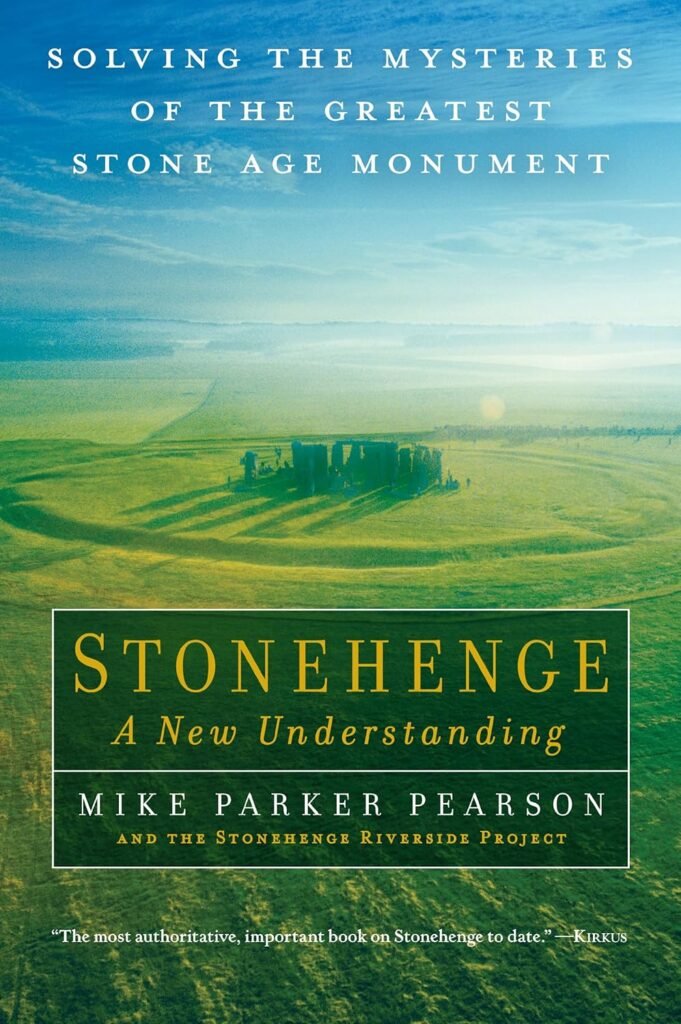
A couple of days ago I finished reading Stonehenge: A New Understanding by Mike Parker Pearson. It was a pretty amazing book, not quite what I expected, although far too long for a non-archaeologist like me to fully appreciate.
I don’t know what made me chose it. It has a nice cover illustration depicting today’s Stonehenge on a kelley green field with the light of the sun creating strong shadows. It suggested mystery, enlightenment, and in retrospect it resembles a cemetery. The top of the cover boldly declares “Solving the Mysteries of the Greatest Stone Age Monument”.
It is a lengthy book, and it took me about a month to read it. There were definitely parts where my eyes glossed over, but interspersed amongst them were sections of real interest. I knew nothing about Stonehenge before I started reading, so I suppose it made it all the more interesting. Throughout my lifetime I heard all kinds of rumors about it, and I suppose I personally believed it was an ancient site of druids and prehistoric astronomers.
It turns out that this collection of stone monuments served pretty much the same purpose we use stone monuments for today: to mark graves in a cemetery.
Huh.
Quite an eye opener, imagining humans of 5000 or so years ago putting their dead in a cemetery. It made me think. Have humans, has the human being as a species, really evolved since the Neolithic age? I’m beginning to think we haven’t.
No one can argue that technology has changed. When I imagine life during the time Stonehenge was first constructed, I think of how people had to live “in the moment”. They didn’t farm, so a great deal of time must have been spent hunting and gathering. You ate whatever you found that day, or maybe as much as a day or two before. You made do with the things you could find or create within a short period of time, such as stone axes and arrowheads, bone needles, clothing made from skins and pottery from nearby clay. You didn’t have the luxury of time to create art and didn’t have any form of communication other than speech. No writing, no books, and no way to tell future generations how to avoid mistakes or how to make life easier.
So people had to learn from each other. People had to depend on each other to eat, defend themselves, and take care of those who couldn’t take care of themselves. Humans were their greatest treasure. Is it any wonder that they would develop respect for the dead? Do we not exhibit similar respect for the loved ones who die today?
In this respect, humans have not changed. Funeral rites and methods of disposal have changed, certainly, but that quality within us that motivates us to honor the dead has not changed.
Mr. Pearson writes that it was likely an honor for entire villages to transport the large stones from the place they were quarried to the Stonehenge site. There was evidence of feasting, lots of feasting at the site. Somehow, in the midst of all their survival busy-ness, these people had time to celebrate being part of a family unit. Ancestors were honored.
It makes perfect sense. It’s not like they had national holidays, barbeque cookouts, or other modern contrivances to use as an excuse for a family reunion. They depended on one another in ways that don’t exist today.
So, as I read through this book, I was struck with the thought that this is not the story of primitive man. This is the story of man living in a primitive situation. Quite a different thing, actually, and something that really brings home the idea that we humans (especially modern humans) think far too much of our assumed “progress”. If our natural thought processes aren’t any different from humans of 5000 years ago, are they really any different from the proto-humans that left the African savanna? Perhaps the only difference is that we’ve figured out how to communicate over centuries, how to grow food on our schedule, and how to build better tools.
Which begs another question: will we ever change? Will we ever be able to shake this illusion that we are something apart from the natural world?
What do you think?
originally posted at annettezimmerman.com