Are you struggling with your art?
It’s fun to draw and paint, no doubt about it. It’s nice when your artwork can also earn a few dollars. But what do you do when your creative work is no longer satisfying? Worse yet, what can you do when your creative time becomes a source of frustration?
It might be time to take a deep dive into your spiritual side. Or, if you don’t like the word “spiritual”, substitute “inner self”. To begin, pick up a copy of “Concerning the Spiritual in Art” by Wassily Kandinsky, find a cozy place to settle in, and spend a few hours thinking about why you create.
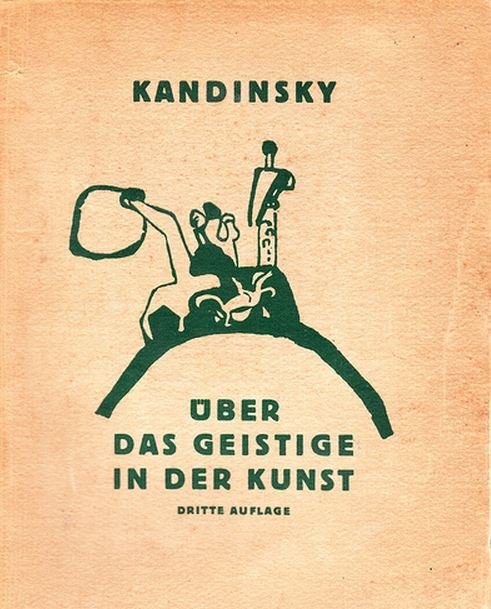
Why Kandinsky Was Important to Art
Kandinsky was an artist who is most known for his influence on the development of abstract art, but his philosophy about the “why” of creating can be applied to all kinds of art and artists. He wrote two books: “Concerning the Spiritual in Art” (I’ll refer to it as SiA) and “Point, Line and Plane” (I’ll refer to it as PLP).
PLP is difficult. If you read it, keep in mind that it’s Kandinsky’s interpretation of color and line, not a common language that can be applied to all art. He had a background in music, so I believe he was trying to apply symbology in art the same way the staff and notes are used in music. This wasn’t a new idea, and it persisted throughout the twentieth century. Nevertheless, it gives us an insight into Kandinsky’s reasoning processes.
SiA, however, is an excellent treatise on the “why” of art. Everyone who calls herself/himself an artist should read it at least once.
In it, Kandinsky argues that art has the potential for communicating universal thoughts and feelings through color and form and, because of this, it’s a spiritual act. Like Robert Henri, who would write something similar a few years later in “The Art Spirit”, he believed that art has no greater purpose than to communicate the human experience at a level that transcends the prosaic.
Much of Kandinsky’s abstract work was an attempt to express his thinking via a common human instinctual response to color and forms. We now know through many experiments that color psychology, for example, is unconscious, not instinctive, but this idea of art as an expression of a common inner spiritual need was almost revolutionary at the time.
In retrospect, it’s not hard to understand why it was such a big deal. The industrial revolution was already in full swing by Kandinsky’s time, and machine made items were in vogue. Photography was available. I don’t think many people wanted an expensive portrait painting or needed a landscape for their living room. They could buy machine made equivalents cheaply (and satisfy that urge for instant gratification). In order for fine art to maintain its prestige, it needed to prove its worth. Get attention. Find a reason for being.
Thus, the expressionism movement, and Kandinsky’s art, was born.
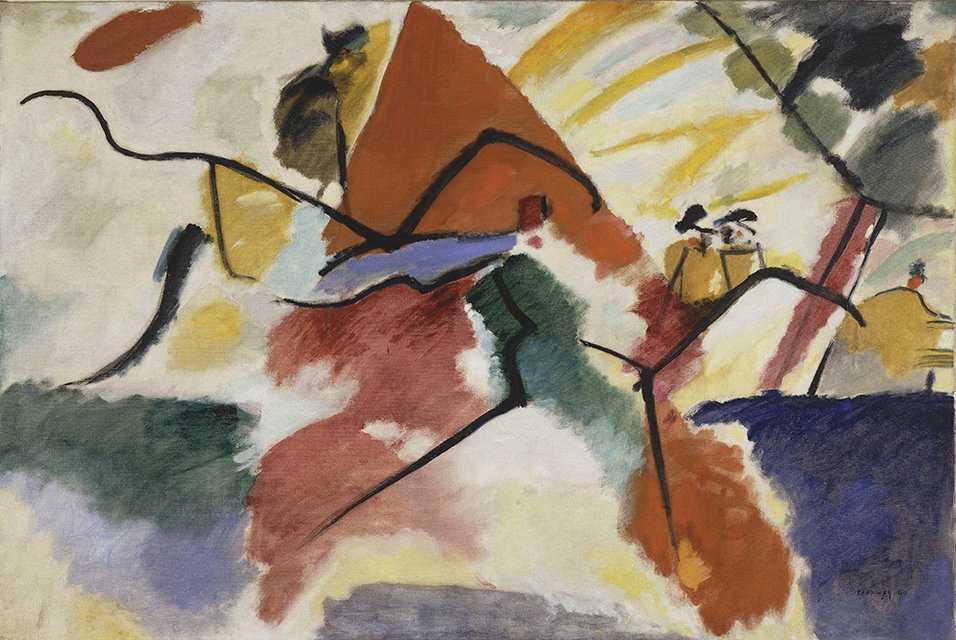
Why would a man who believed art was a transcendental act work at the Bauhaus?
I suppose the idea of a steady paycheck would entice anyone. Plus the ability to teach new students his ideals about art. His theories about color and forms could be applied practically to objects as well as canvas, validating his work. Walter Gropius was well networked and could introduce Kandinsky to many influential people.
With all these incentives, why wouldn’t he join the Bauhaus?
The Influence of Kandinsky on Today’s Art
Kandinsky’s argument for a spiritual basis was, and still is, very compelling. However, it’s rare to see Kandinsky’s influence in my sphere of art (drawing). In fact, I see the opposite. Hyperrealism is currently the predominant trend in colored pencil, graphite and charcoal.
But I see his influence in other spheres. If you look at David Holcomb, for example, you’ll find works that not only express his thoughts and feelings, but also utilize the nature of the materials – a very Bauhaus-like ideal.
My take away from reading SiA is a desire to create art that communicates my thoughts and feelings about the subject I’m drawing. The only way to do that is to know what those thoughts and feelings are. As said by Oceanus to Prometheus, ‘Know thyself!’; know and, I would add, be comfortable with your place in the universe. Humans generally think too much of themselves, tend to ignore questions about our connectivity with the natural world, and are consequently confronted with inner conflict that prevents being comfortable with the self. Finding your ‘why’ is an important step for an artist. It’s not easy.
Fortunately, Kandinsky offers some hope. He wrote
“The spirit, like the body, can be strengthened and developed by frequent exercise. Just as the body, if neglected, grows weaker and finally impotent, so the spirit perishes if untended. And for this reason it is necessary for the artist to know the starting point for the exercise of his spirit.”
How does one find this starting point? Kandinsky asks that artist first recognize their inner need to create, which he believed was built of three elements:
- “Every artist, as a creator, has something in him which calls for expression (this is the element of personality).
- Every artist, as child of his age, is impelled to express the spirit of his age (this is the element of style) — dictated by the period and particular country to which the artist belongs (it is doubtful how long the latter distinction will continue to exist).
- Every artist, as a servant of art, has to help the cause of art (this is the element of pure artistry, which is constant in all ages and among all nationalities).
- A full understanding of the first two elements is necessary for a realization of the third.”
This, to me, is the crux of a real artist and perhaps the distinguishing factor between artist and illustrator (or ‘designer’ in some contexts). When something inside calls for the creation of art, for whatever reason, the artist needs to express it. When there is something in the artist’s society that begs for either improvement or celebration, the artist needs to express it. And if the artist is truly in touch with their inner self they’ll understand that these callings not only require him or her to produce art, but to do so in a manner that is the best he or she can produce without regard to the reception it may receive by others.
No other motivation is necessary. Not payment, nor fame, nor understanding by one’s peers.
Ultimately, said Kandinsky, nature (I would say the universe) has produced in humans this gift to create. It is the duty of the artist to express it.
“Art is not vague production, transitory and isolated, but a power which must be directed to the improvement and refinement of the human soul …If art refrains from doing this work, a chasm remains unbridged, for no other power can take the place of art in this activity. And at times when the human soul is gaining greater strength, art will also grow in power, for the two are inextricably connected and complementary one to the other. Conversely, at those times when the soul tends to be choked by material disbelief, art becomes purposeless and talk is heard that art exists for art’s sake alone…”
This is worth some serious thinking. If you’re struggling with your art, perhaps it has nothing to do with your technical skills. It might not be about the art at all. It might be that you don’t know what you want to say.
Do you have an inner need to create? What do you feel strongly about? Do you believe it so strongly that you can convey it through your art?
“Concerning the Spiritual in Art” is in the public domain so you can read it for free through Amazon Kindle or Gutenberg.
originally posted at annettezimmerman.com