Why practice?
This week’s post is going to be short. Instead of going through a tutorial explaining how I used this week’s limited supply list, I’d like to start a conversation about the P-word.
You know what I’m talking about.
PRACTICE
My inner voice says: I don’t have time to practice. Every artwork I make has to count towards productivity or I’m wasting my time.
I say to it “Unless you’ve been working with your supplies for years and know exactly what to do with them, it’s not a time waste.”
My inner voice says: I’m afraid to practice. It uses valuable supplies. I don’t see any improvement anyway.
Yet what’s more scary? Using up valuable supplies in an effective practice session or using them up on art you put into a drawer? Notice that I said “effective” practice, because if you aren’t learning from what you’re practicing, it’s not effective.
Okay, now that we’ve gotten into some of the, er, challenges to practice, let’s talk about it’s benefits and how you can improve yours. And, as a reward, I’ll give you this week’s limited supply list to practice your practice with!
The Benefits of Practicing
- Practice helps develop your “brain muscle”
If you’ve every tried to enter an athletic competition or played a musical instrument, you already know some of the benefits of practicing. Developing muscle memory is of primary importance. We have some of that in the art world, too, but the main muscle we want to develop is the brain.
Okay, well maybe the brain isn’t a muscle, but I think you get the picture. Wouldn’t it be lovely if, when you’re in the middle of a figure drawing, you know exactly what to fix when the face looks off? Or what colors will mix to get that beautiful dark shadow? Or how to make a line that draws attention to that focal point? It’s a lot easier to do when you’ve done it a few hundred times during practice.
This includes knowing how to fix mistakes. How do you get that smudge of purple watercolor out of your landscape’s sun? Once you’ve practiced it a few times it’s a piece of cake. At the least, you’ll have an arsenal of alternative “cover up” ideas up your sleeve! - Practice helps you discover your style
Style, as it’s related to artists, is nothing more than your artistic personality. You already have it. You could change it (by practicing alternative methods of making marks), but how can you change it if you don’t know what yours looks like? The ONLY way to discover your style is to practice. Make lots and lots of art. Once you’ve drawn a cat a hundred times, you’ll know exactly what your cat style looks like. It’s distinctively, uniquely yours. If, after the 99th time, you decide that there’s something about that cat that you don’t like, you can figure out what it is and deliberately go about changing it. But then you have to practice it again, another hundred times, with the “fix”, to make it a habit that you’ve incorporated into your style.
Let me say this again. If you want to see what your style looks like, you need to practice. A lot. - Practice helps you to let go of expectations
WE all have them. Expectations that our artwork should look like this or that. And if it doesn’t meet our expectation, we’ve failed.
I hate this habit, yet I do it to myself all the time. It’s hard to remember that there’s no pass or fail in art; there’s just art. When you make a mark, it might not be exactly the mark you intended to make, but you made a mark, and there it is. At this point in your life, this very minute of your day, for whatever reason, your subconscious mind has guided you to make that mark. It’s the most perfect expression of you as you are at this moment. Don’t think of it as a mistake, especially during practice, but even during your non-practice art making. It could be part of your style.
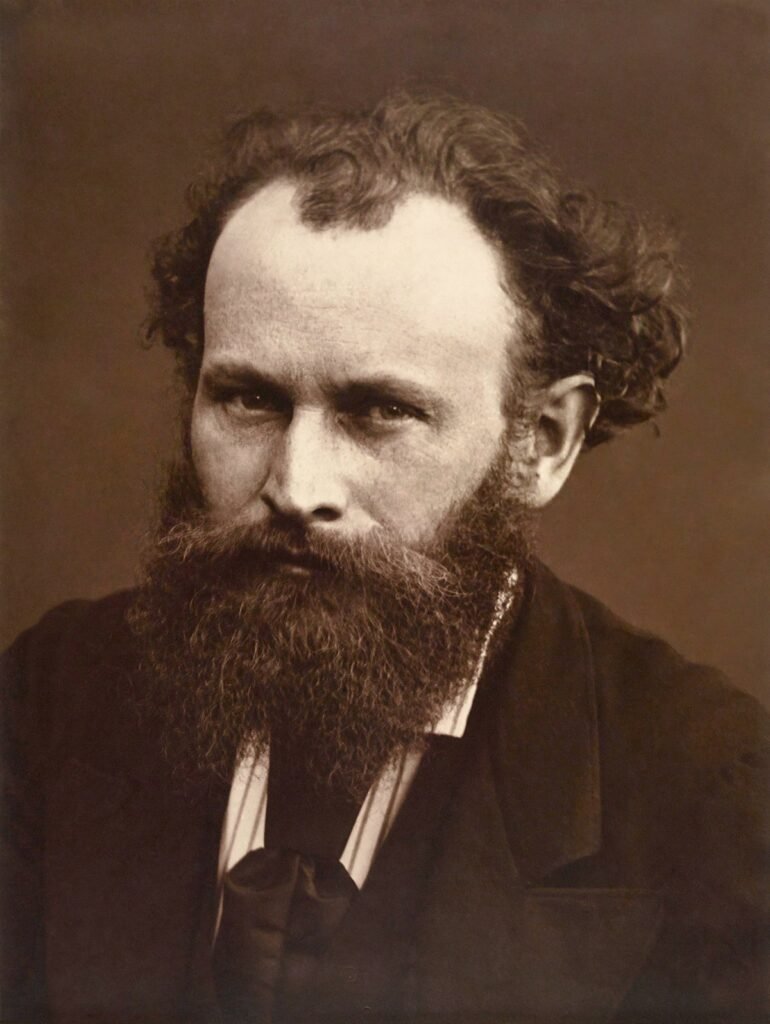
Some of the most beautiful art known to mankind is full of mistakes. I first discovered this while reading about Manet and his, er, questionable skills with perspective. Look at A Bar at the Folies-Bergere, for example.
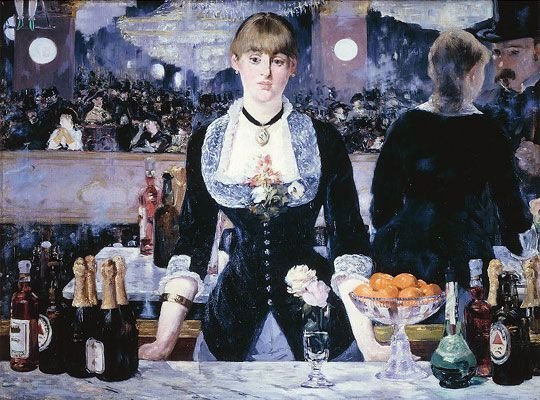
The reflections in the mirror are not very accurate. During his lifetime, his art wasn’t considered “acceptable” by many museums or collectors due to many “mistakes” such as this. But he didn’t care. In fact, one of his most famous quotes is
I paint what I see, not what others like to see.
Manet created over 400 paintings in his life. His “mistakes” with perspective were part of his style. He had no problem letting go of expectations of how the artwork should look like. When the rest of the world sees a Manet, we have no problem recognizing it, nor any issue with accepting that it’s beautiful art as it stands.
I can personally attest to increased comfort with a blank page after a lot of practice with letting go of expectations. This is how I found fun with making practice an adventure, instead. It’s like allowing yourself to wander through a forest without sticking to a path. You never know what you might find!
Practice is an opportunity to experiment
I think we’ve all heard this encouragement. It’s true, but only when you incorporate experiment into your practice. It’s not something that happens by accident.
This is why I like limited supply challenges. They force me to stretch what I can do with a tool or a color.
This was the result of my attempt at this week’s challenge. It forced me to deal with my expectations. I really, really really wanted to add black to my palette. What’s the harm of adding a third color? I thought. No one will know, especially if I just change up the list so it looks like I had the option from the start.
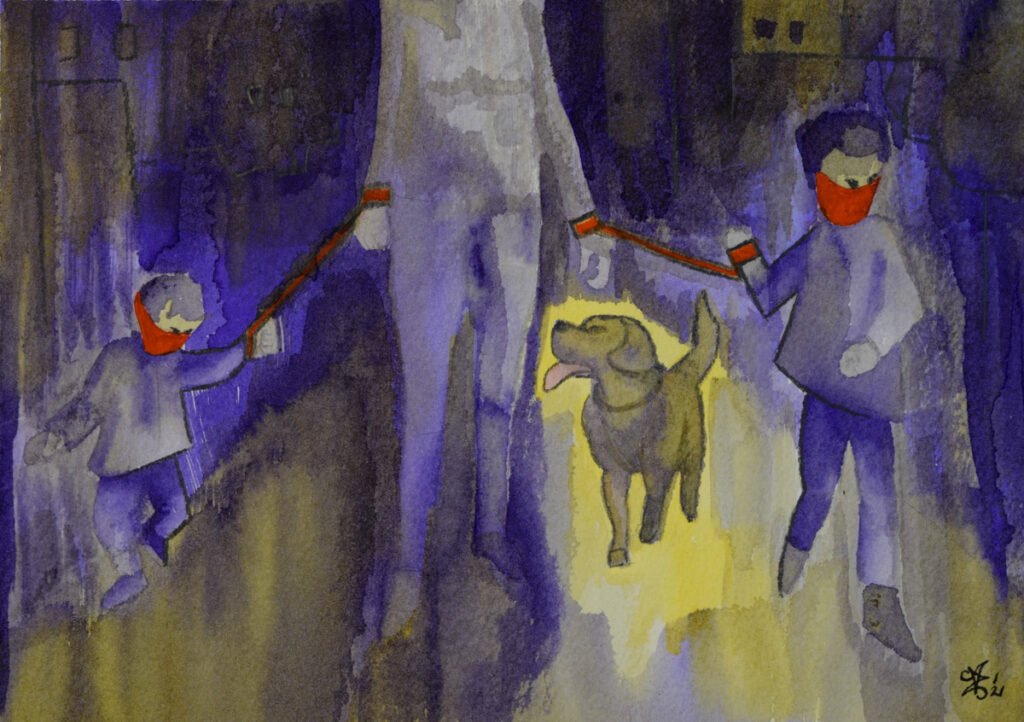
No, I couldn’t be hypocritical like that. I had two colors of ink to work with, and my goal was to see how I could make it work. So I completed the picture with only those colors (plus the gel pen and the graphite pencil).
I mixed those colors every which way I could to make it work but it didn’t come out the way I expected. Yet it’s okay! It’s not beautiful, but it’s good as a starting point for additional study, maybe using 3 colors next time. It’s not the fault of the picture, it’s the fault of my expectations. The only expectations I should have from a practice work are to learn something, and in this case, I did.
That’s what practice is for.
Practice is important. In another post, I’d like to discuss ways to make practice more effective in order to learn faster.
But not today. As promised, here’s today’s mission:
It’s time for you to go practice! Using the mission supplies, find a subject matter that inspires you to create something wonky.
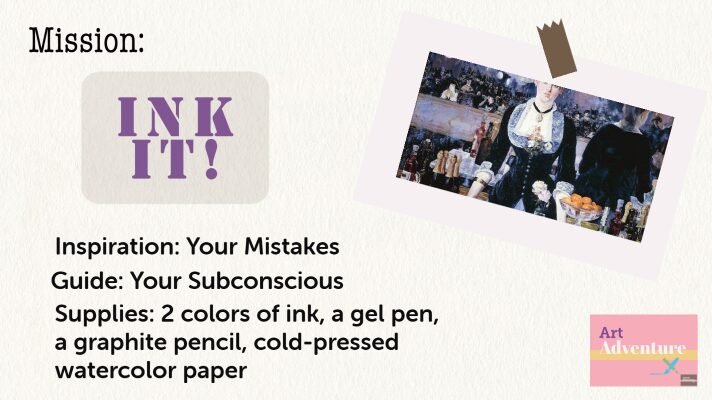
This week’s mission supplies:
2 colors of ink
3 line making media:
A waterbrush
Graphite pencil
Gel pen
Cold pressed watercolor paper
I hope you have fun. See you next week!