Hello friends! I’m sorry, I don’t have any artwork to share with you today. I haven’t had much opportunity to draw in the last couple of weeks. My life has turned completely upside down, and I need to process what is going on, so I thought I’d share this journey that I recently started.
Let me begin with a pleasant memory from last week. We live on a country farm road in the beautiful hills of East Tennessee, and we have very long days in the summer. Last Tuesday (June 22nd) around 9 pm I sat on our front porch watching huge flocks of blackbirds do their nightly dances as they flew from tree stand to tree stand around our home. They make a lot of noise when they roost at night, and, in the last light of the sun, they take their time settling into the branches of the trees that run alongside an ancient cometary next to us. I love listening to them have their last conversations of the day. I imagine they’re telling each other about the day’s hunts, checking on the new babies, observing any recent losses to predators, and conducting flock business matters before they tuck their heads under their wings for the night.
Once the sun fell below the horizon, the birds got quiet, and it was time for me to take care of bedtime matters. I hadn’t been feeling well lately. Abdominal cramps for the last 4 weeks that would come and go and recent bouts of constipation were now affecting my activity and my eating. I’d stopped trying to run a few days earlier because it was like trying to run after eating a Thanksgiving dinner. My last meal was a pancake and a scrambled egg I’d had for lunch the day before. I was tired and out of sorts.
Flashback to Sunday night, when I’d called the tele-nurse for our insurance company to ask if my symptoms were bad enough to warrant a doctor’s visit. That might sound a little silly in retrospect, but I rarely have any issues with my bowels thanks to 21 years of vegetarian-based diet. I honestly didn’t know what would be deemed “serious”.
“Have you tried laxatives or suppositories?” she asked.
Duh. But I knew she had to ask. “Milk of Magnesia does absolutely nothing for this.”
“You probably aren’t getting enough fiber. Have you tried Metamucil?”
I explained to her that I was the Queen of Fiber, but I don’t think she believed me. “Should I go to a doctor?”
“If you think you’ve tried everything and you’re still having problems, you might want to consider seeing a doctor.”
Okay, Decision No. 1 was made. The next morning (Monday) I made an appointment with my primary care physician for Tuesday afternoon. But things were beginning to get painful. I didn’t think I could wait that long. My husband took me to Urgent Care that afternoon.
“You definitely are full of poop,” the young Urgent Care doctor told me after they’d looked at my xrays. “Drink a full bottle of magnesium citrate, followed by two bottles of water. If nothing happens, take a suppository. Then if nothing happens, do an enema tomorrow.”
You can’t imagine how relieved I felt after hearing those words. Yeah, it’s all gross poop-stuff, but that’s pretty easy to fix, right?
But nothing worked. On Tuesday, a miserable me sat in the doctor’s office and listened to him run down another plan.
“Today I want you to drink another bottle of magnesium citrate. I’m also giving you a prescription for Miralax. If nothing happens by Thursday I think you should go into the emergency room.”
I agreed to do it all again, went home, doused myself thoroughly, and waited. By bedtime I was feeling no better. I said good night to the birds, brushed my teeth, and got into bed.
That’s when the vomiting started. It was uncontrollable. Neon yellow liquid and strong abdominal contractions that would stop for just a minute or two before starting again. I grabbed a couple of Walmart bags and asked my husband to drive me to the hospital. This wasn’t going to wait until Thursday.
The ER was busy. Someone else was also puking their guts out as we sat in the waiting room, waiting my turn. By the time I was taken to triage, the yellow goo was mixed with black, and it kept getting more black as as the evening wore on. I think it was after midnight by the time I was taken into the back for a CT scan, but thankfully not more than an hour later I was put into a room.
Three doctors stood on one side of my bed; my husband held my hand on the other. The first doctor (who would be my surgeon) took the lead. “You have a couple of serious problems. Your small intestine has intussuscepted. That means it’s telescoped in on itself and the food can’t go through. You also have a mass in your colon that will have to be taken out. We really need to operate immediately.”
They all stood there staring at me, like I was supposed to say something.
Thankfully, my husband spoke up. He’s always good at asking the right questions when my mind goes blank. “What will you do?”
They briefly explained the intended surgery, and I listened intently. I’ve always been an advocate of holistic healing. Surgery was never something I wanted to undergo. Yet, here I was. There were no other options. They were going to cut up the small intestine to remove the damaged parts, then cut out the mass in the large intestine.
“Okay,” I said, and that was that.
My husband signed forms while they placed an IV catheter. After an injection of Zofram, I stopped the 2.5 hour vomiting spree. For a few brief moments I had some relief.
The respite ended with an introduction to the nasogastric tube. Oh My God.
Up until that very night my worst pain ever experienced had been childbirth, so I’d always used that as my “10” on the Scale of Pain Hell that the doctors use. You know the one I’m talking about? Everyone’s pain scale is a bit different, but a 1-2 on the scale is really light, like a paper cut, and a 10 is supposed to equate to limb amputation. Never having had a limb amputated, I used childbirth because it was several hours of indescribable pain during which it took strong effort just to breathe. Forget about thinking. Forget about anything other than…well, let’s just say it was bad.
Let me tell you, nasogastric tubes are an 11 on that scale. I can’t image limb amputation with no anesthesia being more painful than the insertion of a nasogastric tube.
At first it doesn’t seem to be that bad. They show you this long plastic tube, about the diameter of a pencil, that they plan on inserting through your nose down into your stomach. “Then we’ll use suction to draw the gastric liquids out through the tube,” the nurse explained as he judiciously applied lubrication gel to one end.
“Here, take this,” another nurse handed me a styrofoam cup full of water, covered with a plastic lid and a little bendy straw. “When I tell you to swallow, take a sip through the straw, okay?”
Sounded easy enough.
The first part of the tube went into the nose easy enough, too. Until it hit the bending spot, where it had to go down to my throat. Then it was like someone was yanking my brain out through my nose. Or maybe pulling ice cubes through my sinuses. Tears streamed from my eyes.
I tried to be brave.
“Swallow!”
I sipped and swallowed. Please get this over with quickly!
“Almost there!”
I wanted to retch. I swallowed more water instead. Were my brains coming out yet?
Finally, they got the thing placed and hooked the outside end to another clear plastic tube, just like the kind of tube you use in an aquarium. Only it wasn’t clear water being pumped out of me, but the same yellowish-black liquid I’d been vomiting all evening. They taped the tube to my nose, asked if I was okay, gave me pain medicine.
Immediately after, a nurse waved a long swab in front of my face. “I have to test you for Covid,” she explained. I just tried to nod. Nothing was going to be worse than having an NG tube inserted. And I was right. The Covid swab was barely noticeable.
This was sometime around midnight of the 22nd. I wasn’t sure how long we waited in the ER room, but it didn’t seem like long to me. Eventually I was rolled into a cavernous surgery room. A table was in the middle of it, and thankfully I didn’t have to move a muscle, they simply pulled me over and got my body centered on it gently. I remember thinking Please, Please don’t intubate me while I’m awake…but after the NG tube I wasn’t placing bets on anything.
I watched two nurses pick through sterilized packages of tools on a table nearby while others wandered around me, waiting? preparing? They didn’t seem very concerned. Maybe this was rather routine for them. Oddly, it made me feel a little better, like they do this all the time so there’s obviously nothing to be worried about.
A male doctor introduced himself as my anesthesiologist, and asked a bunch of questions. He put a small mask over my nose and mouth. “This is oxygen. I just want you to relax and breath normally.”
The last thought I remember having was that at least I’d get a few minutes of relief from the pain of the nasogastric tube while I was unconscious.
My husband tells me he only had to wait a couple of hours for them to do my surgery. I cannot imagine the anguish he must have felt during those hours. He had no one there to comfort him; our boys had stayed at home, and quite frankly we’ve never been the kind of people who felt comfortable sharing our personal traumas with anyone, even friends and family. When tragedy hits, you have no control, you have to rely on everyone else for both the information and direction you need to make decisions. You feel very vulnerable and the last thing you want is for someone to see that.
We cope by taking one minute at a time. That’s all you can do. Make it through this minute. Then make it through the next minute. And so on.
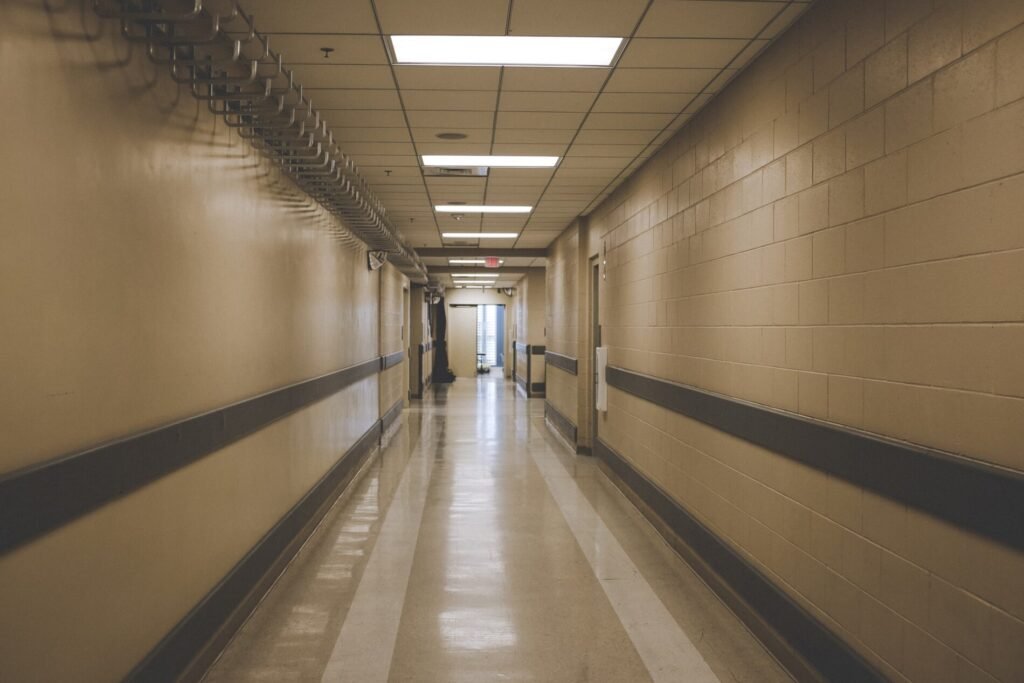
Eventually I ended up in a really nice room in the trauma center. As they rolled my bed in and got me hooked into all the gadgets and bags of fluids that would support my life for the next day or so, I remember thinking “Wow, I get a room all to myself?!” It seemed like a privilege.
I don’t remember much of the first day after surgery, which would’ve been Wednesday. I tried to sleep as much as possible. The nurse handed me a small plastic rod with a button on it. “This is for pain. Press the button if you feel like you need some pain medication. Don’t worry about becoming addicted; it’s all measured out, and there’s a little light that will blink green when you can have another dose.”
This worked pretty good at first. I didn’t have to get out of bed, or move much at all, so the only time I felt real pain was when the NG tube got really irritating. A few days later one of the surgeons would tell me a story about when she was learning about NG tubes in school. “I’ve never had one,” she admitted, “but the guy who was demonstrating how to use them said they got quite comfortable in time.”
That guy obviously wasn’t forced to wear one after major abdominal surgery. It never got comfortable. And the suction tube running from my nose to the pump kept getting caught up on things. Eventually the damn thing pulled itself out. Honest! I did not try to help it, as much as I wanted to, other than to catch it as it slipped down when I was trying to stand up.
The doctors didn’t like that, so I had to have another NG tube placed. This time I wasn’t given any water to sip. They used a slightly smaller tube, but it was still a terrible experience. My IV catheter also had to be replaced, since it was leaking somewhere and everything dripped on my arm. My arms were full of white bandages from blood withdrawals and failed attempts at needle insertion.
My husband laughed that I was looking like a junkie.
On Thursday, the headache hit. I complained to the nurse, but the only suggestion offered was to use the pain button. I had a sneaking suspicion, however, that the pain button was what was causing the headache. So I stopped using it. Completely.
The nurses noticed, of course. I’d tell them my pain scale was a 5-6 and they’d check the little machine on my IV pole to see how much pain medication I’d used. “You aren’t using your button,” they’d say, doubting me.
But I’d rather deal with a level 5-6 painful belly than a splitting headache. I’d already realized there was nothing to be done about the pain from the NG tube. And after a bit the headache went away. I never used the button again.
On Thursday we had a visit from my surgical team. I asked what they found. Had the pathology results come in yet?
They had. My primary surgeon pulled a chair close to my head and sat down. Did I want to hear the bad news or the good news first?
After two days of lying in bed with nothing else to think of, I was pretty sure I already knew the bad news. “Surprise me,” I replied.
She explained that the good news was that they were able to cut out the damaged part of the small intestine. The ‘telescoping’ was caused by several lipomas (fatty tumors) that they removed and tested and were benign. That problem should be resolved.
However…and she began the bad news.
“The mass is an adenocarcinoma. These things usually affect the lymphatic system, which provides fluids to the intestines and sends it back to the blood stream. So even though we took out all the smaller masses around it as well, there’s a chance that this could have already spread to other parts of your body.”
Then she watched me. Just like she did in the ER when she told me she’d have to operate. I didn’t know if she expected me to scream, cry or get hysterical. But I didn’t do any of those things. She’d just confirmed what I’d already been thinking. That was all.
After she left, my husband and I were silent. I felt so bad for him. He’s such a strong man, but he’d just been told his wife had colon cancer. And I couldn’t comfort him. I couldn’t even hug him, while for me, I felt like I’d known it all along. I’d had time to come to grips with it. I was ready for it.
It was an unreal moment.
Finally, I managed to say something. “You know, one of the good things about being a human is not knowing when you’re going to die. Yesterday, I had no idea when I was going to die. Today isn’t any different; I still don’t know. We just have to take each minute as they come.”
So I kept doing that. I kept breathing. I kept noticing when I had pain, noticing how the sky changed in the view from my window, noticing how people wore their hair and the smells of the hospital and comfort of being buried under warm blankets on a bed. It’s a skill that gets more refined the more you use it.
I call it noticing, but it’s really becoming intimate with everything involved in the experience of living. Each breath, each look, each touch becomes interesting. Maybe some people learn how to see these nuances in the world around them so that they can experience life more fully. Like artists who experiment constantly with the slightest changes in color or the smallest twist of a brush, always trying to get this indescribable thing in the mind onto the canvas. When you really start noticing, nothing is ever the same. I don’t really know how to describe it. It’s a complete appreciation and respect for life.
Does everyone who undergoes a life-changing event go through this? I wonder.
originally posted at annettezimmerman.com