Part Two
This is the second half of the story of how cancer changed my art. It’s a somewhat long story, which is why I’ve broken it into two parts: Part One is about what I went through after my diagnoses while this part is about my renewed return to creativity.
Prior to my cancer diagnoses and consequent surgery, I didn’t care how long it took to create and I didn’t overly worry about going down rabbit holes during the creative process. After my first chemo treatment, when permanent neuropathy became a real possibility, I felt like I was suddenly under a lot of pressure to accomplish something worthy. I worried that I would lose some of my hand functions and never be able to draw, paint or knit like I had in the past.
I decided to take some action to prevent this from happening.
First, I told my oncologist that I would no longer take the chemo drugs he prescribed and wanted another solution. I was taken off the CAPOX regimen and put on a tried but true 5FU and Leucoverin regimen, to be administered every two weeks. Thankfully, the side effects I’ve experienced on that therapy have been minimal, although I have lost my fingerprints. Once I recuperated from the August fiasco, I was able to begin running again and get back into my studio regularly.
I also bought a cream that was touted on the cancer forums as being remarkably restorative for chemo-skin. It has a high urea content (10%) and, so far, I’ve not had any problems with skin pain or redness. It has, however, eaten through two pairs of nylon socks over the course of 4 months, a compromise I’m willing to take to keep my skin healthy.
Finally, I made my studio time a priority and decided that I would make art in some form every day, even if it meant being lax in other areas of my life (usually housecleaning). I would make something important, something that I could leave behind if the worst ever happened. Obviously we all die sometime, but now I felt like my time could be sooner than I’d hoped.
Have I made anything remarkable since then? Sadly, no. I’ve made lots and lots of what I consider “practice” pieces, and some of them are quite pretty. But nothing seems worthy of exhibition. My short term goal of producing something marvelous fell completely apart. I became really depressed as my expectations were continuously unmet.
Then, in December, I had an epiphany.
I realized that the problem wasn’t with my art or my desire to create art. It was the feeling of being a victim. I blamed cancer for the chemotherapy I was taking, and felt like I was a victim of circumstance. I was experiencing a lack of control over my life, particularly over my future. To compensate, I set up this expectation that I could create a masterpiece (several of them, actually) in a short period of time, fulfilling my desire to leave a mark in the world before cancer took over (and possibly life ended).
Being a victim is a tough way to live. I felt like I was constantly needing to justify my actions, especially to myself. Every day that I couldn’t work on artwork was a day I had to find excuses for. It’s difficult to explain.
I’m a Type 5 on the Enneagram personality scale, the kind of person who is always turning inward to find peace and contentment. Once I started feeling out of control, with the real possibility of being incapable of creating art, I became a victim of this fear. I no longer found contentment with what I was creating because I couldn’t possibly meet this huge expectation to immediately make something magnificent.
After a lot of introspection, I decided I no longer wanted to feel like a victim. That meant letting go of the fear of being incapable, which admittedly was easier to do after 3 months of recovery time. Even though I know the side effects could still occur (some people don’t see them until 3 to 5 months after chemo ends), I’m not yet seeing any impacts on my creating process. This gives me some hope that I won’t ever experience them.
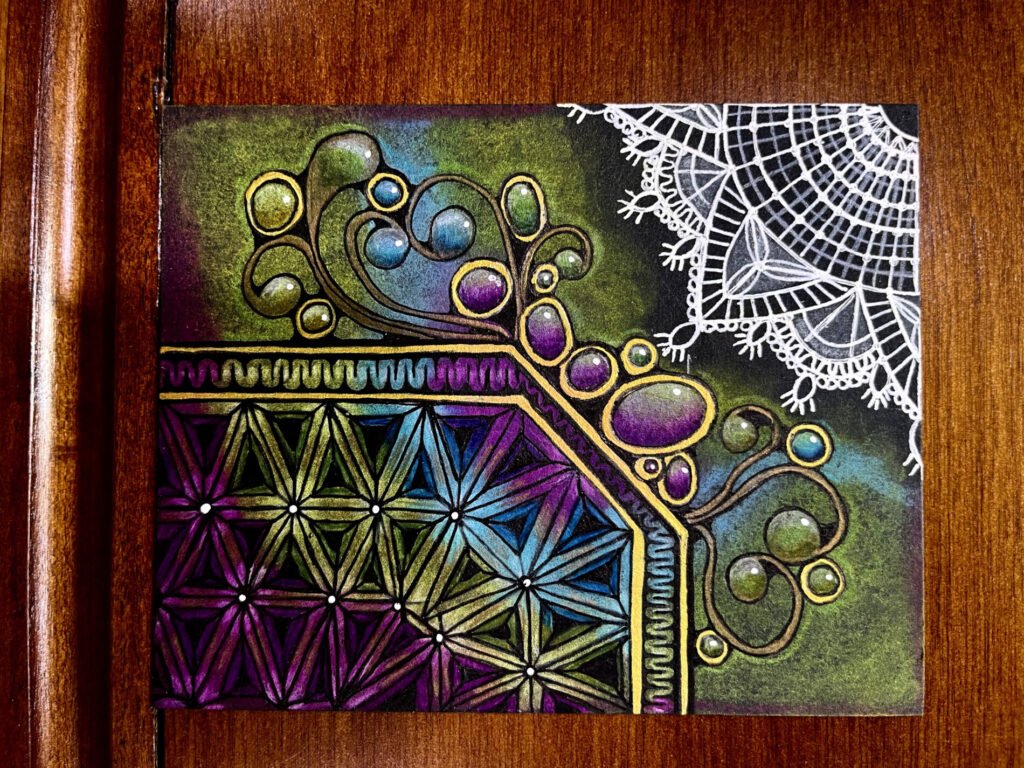
Even so, during this recovery time – primarily due to my increased time in the studio – I’ve been able to explore alternate forms of art. In fact, I’m discovering that abstract art is more fun than realism. And abstract doesn’t require fine lines and detail! So even if I have problems in my hands eventually, I feel confident that I can still create beautiful things.
Letting go of fear is not easy. I think artists feel lots of different kinds of fear, like the fear of not being good enough, or of not being able to produce anything “worthy” at all. As victims of fear, we find other excuses for our inability, like not having the right space, the right materials, or the right time. In reality, these are only excuses. Beautiful things can be created within the space of your arm’s reach, the simplest of materials, and the shortest time.
Having cancer and going through chemotherapy has taught me that I have to face my fear in order to get past excuses and false expectations. Getting beyond fear has given me the confidence to move forward with “it’s okay to create for the joy of creating”. I’m still spending lots of time every day in my studio, but, now that the pressure is off, I’m actually enjoying it so much that I need no excuses. I need no purpose for being there. The pure experience of making a mark and watching the pen glide on the paper is joyful.
Cancer has given me a gift. It has changed how I view my artistic process. When I’m in my studio, surrounded by pencils, tubes of paints, pads of paper, and my own practice pieces hanging on the walls, I’m the artist that I’ve always wanted to be. Things will change, perhaps suddenly, due to cancer or chemotherapy, or perhaps more gradually due to a body that naturally degenerates. The only real choice I have is to decide whether or not I want to enjoy the moment or worry because of fear.
Guess what? You have that choice, too.
originally posted at annettezimmerman.com