I’ve recently finished two new pieces connected to Jonesborough: an illustration of the Southern X450 at the Chuckey Depot Museum and a sticker for the National Storytelling Festival.
They’re very different pieces, but both began with the same question: how do you make artwork about a place without simply reproducing the version that already appears in all the brochures? Jonesborough is usually represented by its brick sidewalks, historic buildings, and extremely photogenic courthouse. Those are genuinely part of the town, but they aren’t its entire personality.
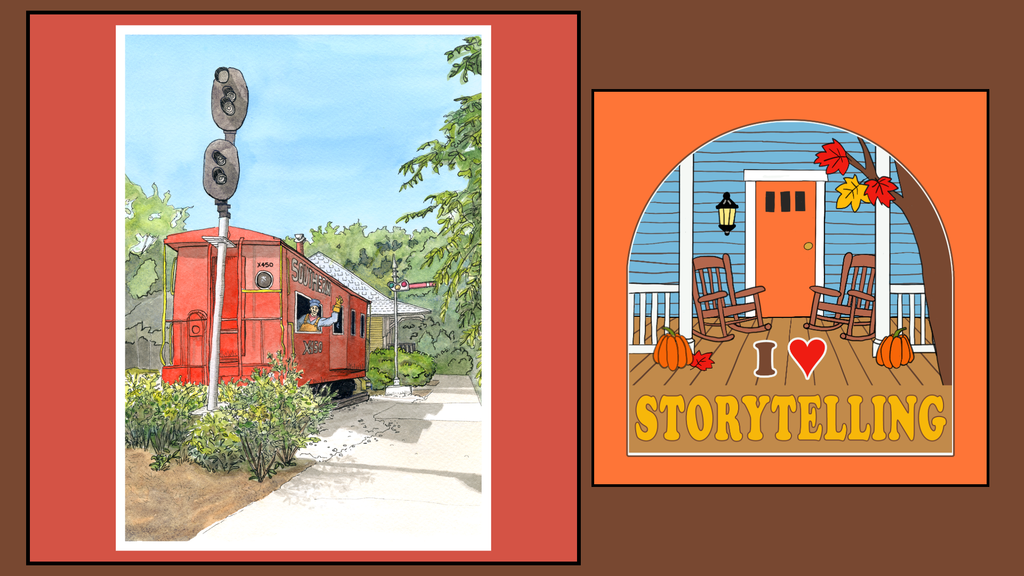
These two pieces look at two of its other identities: Jonesborough as a railroad town and Jonesborough as a storytelling town.
The View Beyond the Depot
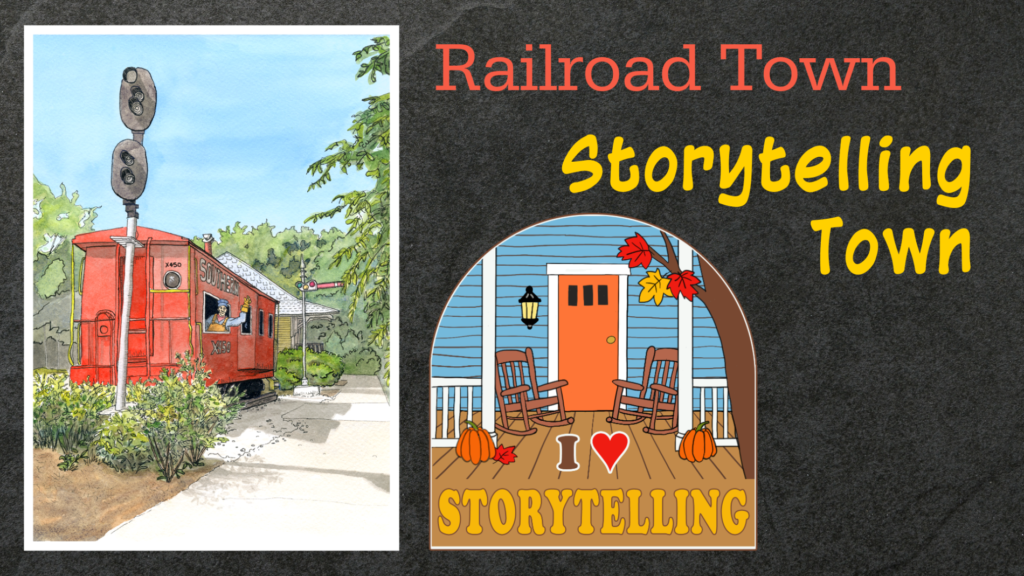
The Southern X450 illustration began with a photograph I took at the Chuckey Depot Museum. It isn’t the standard view of the depot. The caboose and railroad signal dominate the scene, giving it the feeling of a working railroad environment rather than a carefully arranged historical attraction.
That was what interested me.
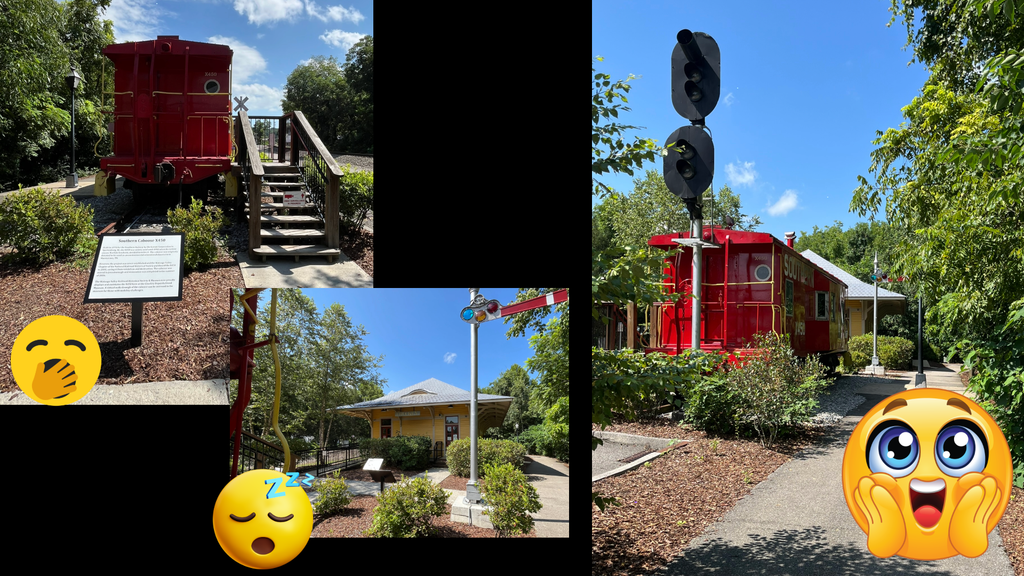
The Southern X450 originally ran for the Southern Railway system before spending years beside the tracks in nearby Chuckey, Tennessee. It was relocated to Jonesborough in 2005 and restored by the Watauga Valley Railroad Historical Society, with the work completed in 2016. Its survival is a small monument to the people who decided this piece of regional railroad history was worth saving.
The caboose, signal, tracks, and surrounding landscape already provided a strong composition. My job was to decide which details carried the feeling of the place and which could be simplified. I wanted the artwork to belong to a real location, but also to the slightly altered world of Realmscapes. I wasn’t trying to reproduce the photograph exactly. I wanted recognizable shapes, lively lines, and just enough wonkiness to suggest that reality might be leaning slightly to one side.
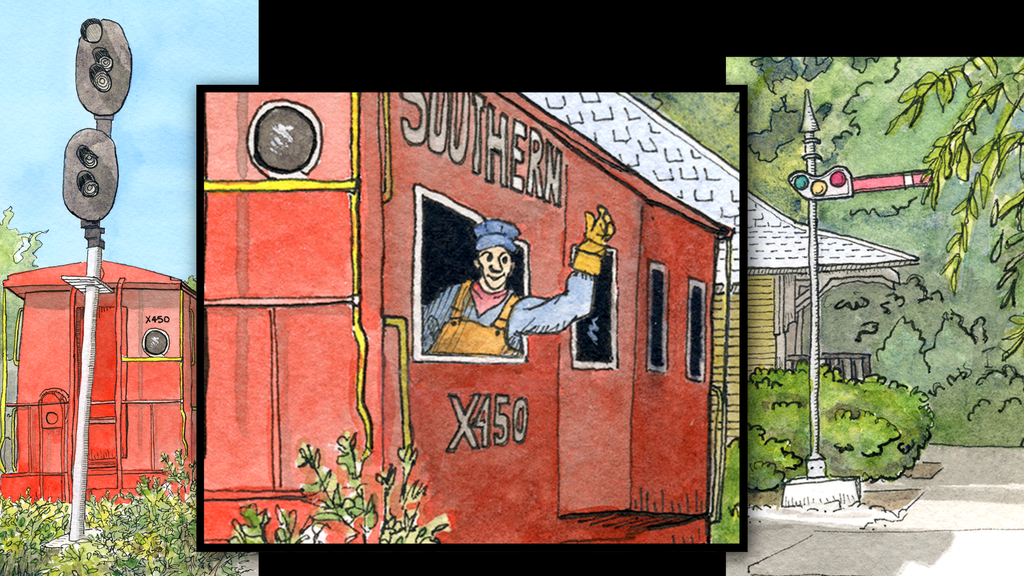
That act of simplification is becoming increasingly important in my work. A photograph contains everything: every edge, shadow, patch of gravel, piece of machinery, and distant object. An illustration has to decide what matters. If I include every visible detail, the result may be accurate, but it won’t necessarily feel alive.
The Southern X450 also gave me an opportunity to work with a subject that isn’t conventionally picturesque. Railroad machinery is large, mechanical, and built for a practical purpose. Once it has been retired and placed in a museum, however, it becomes something else. It becomes evidence that the town had another life before the present one.
That’s the small hint of mystery I like in local artwork. Not a ghost lurking behind the caboose or anything quite so obliging—just the awareness that other people once stood in this place for entirely different reasons.
In this case, I added the Caboose Man: the figure I remember waving to as trains passed during my childhood. His presence changed the scene. The caboose was no longer a sterile museum object; it became part of a working train again, with a person aboard it and somewhere yet to go.
After finishing the artwork, I prepared it as a print. That’s the point at which an image leaves the fairly forgiving world of the screen and becomes an object that can travel out into the world on its own.
Imagining Doc’s Front Porch
The second project began with the idea of making a sticker for the upcoming National Storytelling Festival. I wanted it to feel like autumn in Jonesborough without simply producing another arrangement of pumpkins and leaves.
One of the Festival venues is called Doc’s Front Porch, where local storytellers perform. It isn’t actually a front porch—but I began wondering what it would look like if it were. That imagined porch became the center of the design.
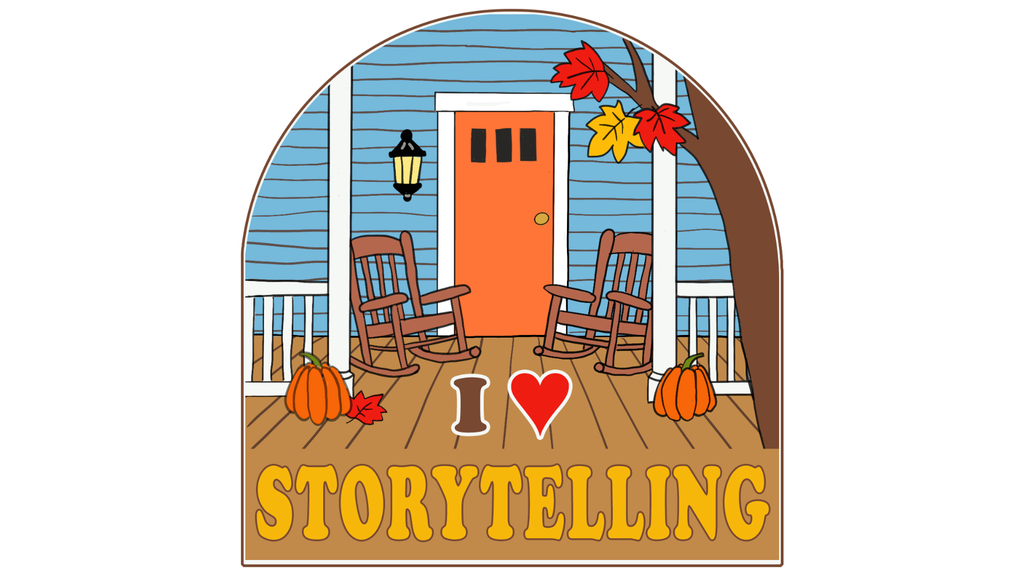
Storytelling in Jonesborough isn’t connected only with stages and tents. It also carries the feeling of people gathering, sitting together, and listening while someone tells a story. A front porch seemed to capture that feeling more intimately than another picture of a festival tent.
“Doc” was the nickname of George McConnell, a storyteller who helped establish the Festival during the 1970s. That history made a warm, nostalgic style feel particularly appropriate for the design.
I chose a color palette inspired by the autumn television specials of that era: cheerful but not aggressively bright, nostalgic but not faded. I wanted the sticker to feel familiar without looking as though it had spent fifty years in a shoebox. The finished design includes the porch, fall decorations, and the words “I Love Storytelling” in the section underneath. The shape is slightly more unusual than a standard circle, giving the sticker a silhouette of its own.
Creating it required a different kind of simplification from the Southern X450. The railroad illustration had room for atmosphere and small details. The sticker needed to remain readable at less than three inches wide. Every line, shape, and color had to earn its tiny portion of real estate.
The finished sticker isn’t a literal picture of Doc’s Front Porch. It’s my imagined version of what the name suggests: a welcoming place on an autumn afternoon where someone might sit down and begin with, “Have I ever told you about the time…?”
Two Ways of Telling a Place
These two projects represent different parts of making art. The Southern X450 was about looking at an existing place from a less familiar angle and deciding what made it worth drawing. The Storytelling sticker began with a real name and history, then wandered into an imagined setting.
One preserves traces of what happened here. The other creates a place where stories might happen. One became a print. The other became a sticker. Together, they capture two versions of Jonesborough that interest me: the railroad town carrying its past forward and the storytelling town still gathering people together in the present.
Perhaps that’s what I’m looking for when I make artwork about a place—not a complete inventory of what stands there, but the particular detail that makes me wonder what happened before I arrived, or what story might begin next.
What do you look for when you make artwork about a place? Is it the familiar landmarks, the atmosphere, a personal memory—or the small detail that tells a story only you might notice?