I’d walked into the coffee shop on a Tuesday afternoon for a drawing meetup I’d found on the FADE website. I had a break between two work events, and this seemed like a better way to spend it than sitting in my car at a park, sketching another tree. I’d brought my sketchbook and tablet, so I had something to do even if no one showed up, and bought a mocha.
The sign on the table said I was in the right place. That was reassuring, because nobody else was there. And for the first five or ten minutes, I had the table to myself. Then Laura arrived and introduced herself.
I had Procreate open on my tablet. I think I was working on a sticker for the storytelling festival, but whatever needed done soon lost my attention. Laura was telling me about FADE and what she hoped to accomplish through it.
I’d come expecting to meet people drawing together over coffee. What she described included artists helping people who wanted to become artists, sharing skills and making opportunities possible. I kept listening. This was something I’d been looking for for awhile.
In seventh-grade art class, a teacher gave us manila paper and pencils and asked us to draw whatever we saw in front of us. My best friend was sitting across the table, so I drew her. I’d never attempted a portrait before.
The teacher thought it was good. She took the drawing, and I never saw it again. Months later, I learned that she’d entered it in an art show and told my parents. My parents hadn’t told me. Art wasn’t important to them. I have no idea what became of that portrait, but I still remember making it.
By ninth grade, I was spending serious time learning to draw. Buildings and animals were favorite subjects, and I was getting good at them. With encouragement and some advice, I might have continued taking lessons. I might have considered art school. It probably would have been an easy choice.
Then my family moved to Long Island, where I entered a competitive public school system and the art teacher paid little attention to me. I never asked why. I didn’t know how to ask for help figuring out whether art could be part of my future. Without that conversation, it never became a career I seriously considered.
At eighteen, I joined the Air Force because I needed somewhere to sleep and food to eat. I hoped it would give me a career, too. Four years later, I was out, with a little more understanding of what I needed and no clear way to get it.
Technical school came next, then work, and raising children. Eventually, with my husband supporting the family and loans making college possible, I went back to school. A motivation test helped me consider possible careers. Engineering wasn’t the strongest interest it identified, but it was the strongest one that promised good money.
It was a good decision. I enjoyed the work, and it paid well. There were trade-offs, some of which I didn’t recognize until retirement gave me time to notice the parts of myself that still wanted attention. Including my need to create, which never left no matter what career I was pursuing at the time.
Sometimes I wonder what might have happened if someone had sat down with eighteen-year-old me and explained how to go to art school, what creative careers existed, and how people found their way into them. Back then, I couldn’t weigh opportunities I didn’t know I had or possibilities I never thought existed. That’s something I’d like to help change for another girl.
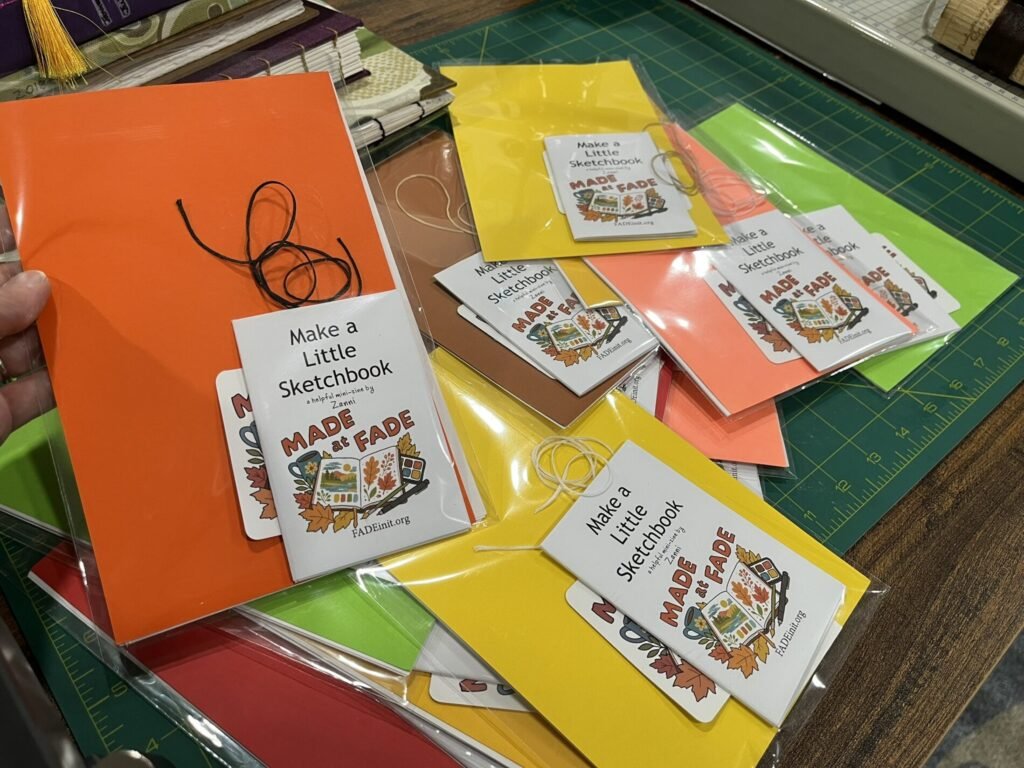
I’m preparing to teach a little sketchbook-making class this weekend for a FADE event. There are papers to cut, stickers to make, and materials to organize. It’s a modest thing to offer, but it gives me a way to participate and share something fun. I expect the audience will be adults, but maybe there will be a few younger girls there, too. I’d be interested in hearing what they think about their future in art; interested in finding a way to give others the advice, support and encouragement that I didn’t get when I was young.
I’m thinking it was a good decision to walk into that coffee shop a few Tuesdays ago.