This story was special because it was written and recorded in isolation. During the COVID lockdown, the cast couldn’t meet together in one room, but the show still had to go on. Phyllis, our brave and patient stage manager, made that possible by traveling to our homes and recording us one at a time as we read our parts.
In some cases, she even had to use online apps so two actors could record their lines together from different locations. It took a great deal of patience, planning, and technical wizardry to turn all those separate recordings into a complete performance, but she did it. Thanks to her work, the show went on as scheduled.
I worked with a lot of good people while performing for the Storytown Radio Show, and I’m grateful to have known them. Writing scripts helped me grow as a writer, but performing them taught me something different. It helped me step out from behind the page, trust other people with the words, and become a little braver than I had been before.
Soon after the Covid-19 pandemic started I saw a post on Facebook from my sister that said they’re out of toilet paper. Completely out. And there’s none at the store. She was panicked, because she’s taking care of her grandchildren so her daughter can work, two little kids who just started school. She didn’t know what she was going to do.
And some guy posted on her page
Don’t have a cow, man.
What was that supposed to mean? Let’s not even talk about if it was helpful, because obviously it wasn’t. We all know it’s just something people say, usually when they think someone is overreacting.
Don’t have a cow. As I say it, it means one thing, but when you see the words in print they take on a whole different meaning. As if, literally, my sister’s reaction was as bad as if she’s birthing something really big, man, like a cow, man. Like dealing with wiping little kids butts without having any toilet paper ain’t that bad.
Not like she’s giving birth to a cow.
Seriously? Well, it did made me think. First, even though I can’t speak for cows, giving birth is more challenging than figuring out substitutes for toilet paper, although I’m not so sure that this guy had any expert qualifications for either. But my sister’s had two children and knows all about the challenges of dealing with childbirth. It changes your life. Kind of like this crisis we’re all dealing with right now. In fact, I would go as far as to say that most women who have birthed children would have expert qualifications for dealing with the pandemic simply because they’ve got experience in dealing with major life changes.
Think about it. When you’re going to have a baby, you’ve got no idea what’s in store for you. You think it’s going to be fun and exciting and at the end of nine months you’re going to get this cute little bundle of Baby. Especially when it’s the first one. That was me. I thought the worst would be over when my pregnancy ended and my first born was safely home. I was mistaken.
When Baby comes home from the hospital everything in your life changes. First the schedule – my life now revolved around Baby’s stomach. It was grueling, too, and unpredictable. Waking up several time at night to feed him. Leaving a half full grocery cart in the aisle and running out to the car to feed him. I learned to get the ice cream last because it would melt by the time I got back into the store.
That’s how I dealt with that change. I improvised.
I’ve been reading about people complaining about how their routines have changed during self-isolation and I think, yeah, it’s tough. But you don’t know how bad it can be. You don’t have to get up every four hours all night long to do your work. For months.
Yep. Pity the new mother.
Speaking of self-isolation. It’s cut and dried that every new mother has a lot of experience with self-isolation. Baby has no immunity to anything and I happen to be genetically disposed with extra amounts of the Protectogen hormone that makes women avoid social interaction when they have kids. I was the one who wanted a detailed medical history for anyone who wanted to get within 6 feet to look at Baby. Don’t bother asking to hold him because I’d have to ask about your immediate family members, too. Everyone thinks a new mom wants to stay at home because she hasn’t got her figure back, but the truth is she’s naturally self-isolating to keep Baby from getting sick.
Yep. And she’s too tired from being up all night to want to go anywhere.
Then there are all the other changes. Decisions. Trying to figure out what diapers to use, what bottles to use, the right car seat. The panic that set in when I first got on an airplane with Baby. All those people were breathing on him! Eventually we had to deal with learning how to accommodate safety devices on outlets and baby gates that stopped the traffic flow in the house.
At least all I have to do during Covid-19 is wipe down doorknobs and counters and stuff – really nothing more than the what I normally do during my weekly cleaning anyway.
Then there are the changes due to breastfeeding. A higher concern for my own health. I can’t eat this and should eat that. I want a hamburger! But I can’t have it. It would be bad for Baby.
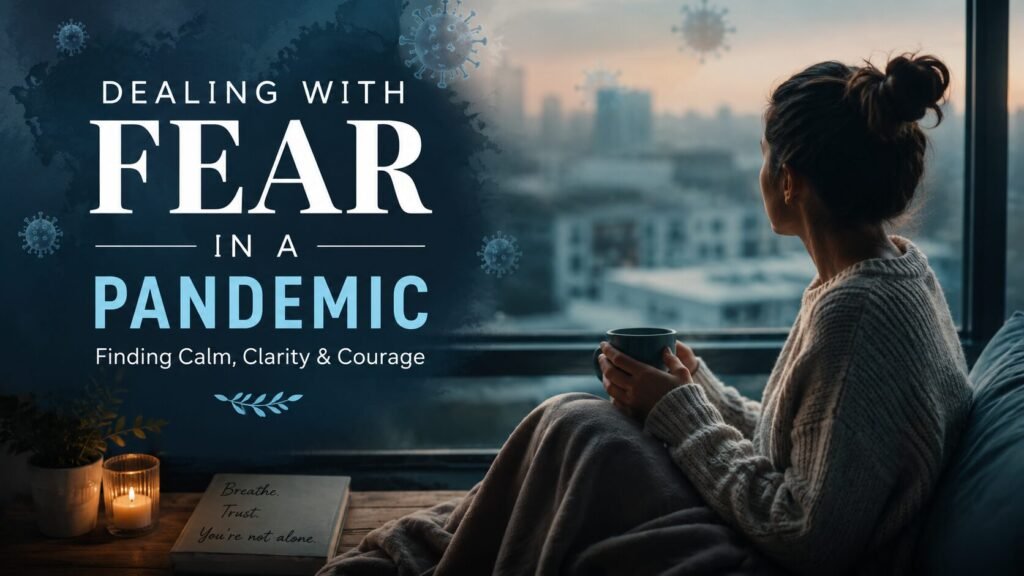
The truth of the matter is that childbirth, like the coronavirus pandemic, involves fear. Fear of the unknown. Fear of things that could lead to suffering, or even death. If I wasn’t careful, Baby could get sick or die. What a heartbreak that would be. So I’m willing to take on change to protect what I love.
But that’s the way life is! Nothing is permanent. We don’t know what’s going to happen tomorrow, or the next hour, or even in the next minute. Fear is a necessary emotion, we need to be able to react if we’re in danger and fear stimulates appropriate responses.
But fear can get out of hand. My fear of airplanes nearly stopped us from having a nice vacation. My fear of getting coronavirus might cause me to hoard food that someone else might need more.
Fear causes change, too. But change, in itself, isn’t bad. It’s what we have to do to live.
We have babies because we have hope. We want a piece of ourselves to live on even when this body is gone. And so we deal with incredible amounts of change because we hope that the changes will turn out for the better even while we fear the worst. And that’s what we have to do now. Hope that we can save lives because we’re taking measures to slow the spread of the virus. Hope that we’ve learned how to manage pandemics effectively so our children won’t have to suffer with worse diseases in the future.
Keep our fears in perspective, realizing that most of the fear is of the unknown. Of change.
It takes courage to raise children, especially when you run out of toilet paper. It takes courage to create new habits during a pandemic. But it can be done – if we’re not afraid of change.