Today’s post is about food. If you’ve ever gone a week without eating anything, maybe you can relate. Or if you’ve been in a hospital far longer than you wanted to be, you’ll be able to relate. I promise it’s the worst of the hospital stay. Things got better once I was able to go home.
But let’s start with food.
Hospital food always gets a bad rap and in today’s hospitals I’m not sure why. Nearly everything offered to me the first couple of days I could eat came from a package. I can’t say it was good, but it wasn’t different than what you can buy at the grocery store, so if you like that kind of food (especially lunch box snacks) you’re in for a pleasant surprise.
But if you’re a person accustomed to a home-cooked, vegetarian-based diet, the hospital food wasn’t really a good thing. My packaged Jello tasted off (it is made with apple juice instead of water), packaged peaches were too sweet (they have added fruit juices) and the canned tomato soup had a bitter taste. But it was food, and since I was allowed to eat again I did my best to try a few bites of everything they gave me.
On Monday, the early morning doctor was encouraging. “You’re doing much better,” he said, looking at my incision. “If you have no problems today, I don’t see why you can’t go home tonight.”
I now had a wonderful new goal. Although all the nurses and doctors and staff had been absolutely fantastic, it would be lovely to sleep in my own bed! Actual, honest to goodness sleep, not the 2 hour naps that I was allowed to take in between various activities needed to support me in the hospital room.
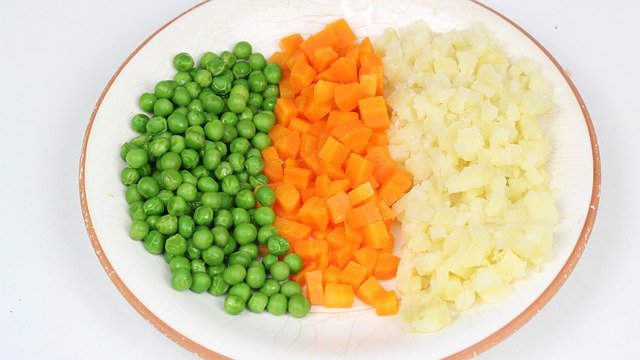
To prove my fitness, I was allowed to progress to a soft GI diet. I didn’t know what that meant, but it sounded better than the farina I was offered for breakfast. My lunch meal was brought up on a lovely big tray with a covered dish. I removed the cover with great anticipation, relishing the thought of eating something more substantial than broth and Jello. Surprise! It was a dinner plate prettily divided into 3 sections: boiled peas, boiled cubed carrots, and boiled corn.
It was a bit of a letdown. Not that I didn’t appreciate the veggies. But did they know how much fiber was in that corn? Would my newly sutured intestine be able to handle that? Unsure, I left the corn untouched and ate half the peas and carrots instead. But while I ate, my confusion grew. I’d been watching hours of the hospital’s nutrition channel, which showed healthy foods like vegetarian wraps and stir-fry being fixed and offered to happy diners. I wondered why I was being given pre-packaged snack food and veggies from a can.
I asked the nurse if she’d watched the hospital’s nutrition channel. She actually laughed! “When we get lunch,” she confided, “our cafeteria choices are french fries, hamburgers and hot dogs. I think there’s a difference between what people say they want to eat for good nutrition and what they’ll really buy.”
Maybe. But I wondered if my request for vegetarian food was the problem. Was it because I didn’t want hamburgers and hot dogs? Maybe the cafeteria folk didn’t know about the hundreds of delicious ways to fix vegetables and whole grains, or even that pasta, fruits, and rice were all vegetarian.
When a gentleman from the kitchen came to take my lunch order, I asked for something different than plain canned veggies. He thought about it for a minute. “Vegetable soup?” he asked hopefully.
I sighed and nodded.
On Tuesday, the day I was “supposed” to be discharged, the hospital’s Hospitality supervisor paid me a visit. “How has everything been for you? Has housekeeping been doing a good job? How about the cafeteria?”
I explained that I didn’t think the cafeteria knew how to make vegetarian food. “Have they ever heard of tofu?” I asked. “Or soy or almond milk?” After all, we did live in East Tennessee, an area of the country that prizes menus of meat, potatoes, biscuits, gravy and sweet tea.
He seemed taken aback. “Of course we have those things. All you have to do is ask for them.”
“Even chocolate almond milk?” I asked hopefully.
He smiled.
After he left, I quickly rang for the nurse and asked her to change my lunch order. I could hear her arguing with someone on the phone, but I was prepared to refer her to the supervisor if it came down to it. He almost promised me something delicious, and I desperately needed some energy. Canned veggies and packaged snacks weren’t giving me what I needed to even walk a short distance down the hall.
Thankfully, my last meal in the hospital was a delicious vegetarian stir fry with tofu, a fruit plate, and a glass of chocolate almond milk. It was delicious! I nearly cried with happiness, savoring every bite I could eat. Half the plate filled me up, but I kept nibbling anyway. When the nurse came in to see how I was doing I practically gushed with gratitude.
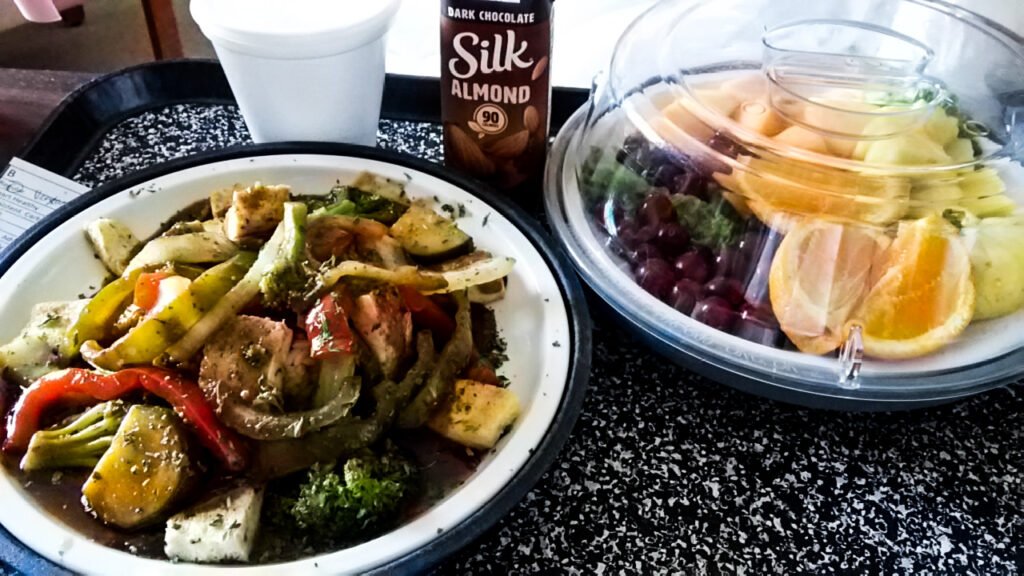
Our hospital truly has one of the best chefs in the county – as long as you know what to ask for.
But I’m getting ahead of myself. Let’s flash back to Monday, the day I’d been led to believe I’d be discharged. They pulled my IV catheter and I waited anxiously for the word that I could go. But it never happened; by the time the paperwork was ready to be set in motion it was too late to get the home equipment I needed, particularly a walker and a 3-in-1 commode. Then, while we waited for the nurses to see what strings they could pull to get us the equipment, someone found a discrepancy in my lab work.
The evening nurse came on duty and took over. “I’m sorry to have to be the one to tell you this, but your potassium levels are too low. We can’t let you go home tonight.”
I was devastated. My labwork had been pulled early that morning around 5 am. They had all day to correct this issue, and they only now discovered it at 8 pm?
My husband, who had been fuming all day while we waited for my discharge, was finally allowed to go home and get some sleep. I, on the other hand, was in for a night of pure hell. In order to bring my potassium levels up quickly, they wanted to give it intravenously. Never mind that my IV catheter had already been pulled; they’d find some vein on my bruised and blackened arms that hadn’t been collapsed and put another one in. Oh, and by the way, I’ll have to be connected to an EKG machine all night to monitor my heart, because potassium sometimes affects the heart muscles in a bad way.
I pleaded for another option. The last thing I wanted was to be connected to a bunch of machines again. Hadn’t I moved past that? I promised to eat lots of bananas. Wasn’t there a pill for this? I felt myself getting a little hysterical. Too many sleepless nights, too little good food, and a constant pain in my abdomen were taking their toll.
Turns out there is an oral option, but it takes longer, as was explained by my impatient nurse. The injection would only take a night. Who knew how long pills would take?
My tears were having no effect on her. Obviously she needed to get back to other things, like checking her email. I wanted to say mean things, but I bit my tongue. She was just doing her job, I told myself. Let her get on with it and get it over.
So I was connected up to more wires for the EKG, given a new catheter in a really bad place on my thumb, and the IV flow began.
“Some patients say it stings,” the nurse warned me. How could stinging be any worse than what I’d already gone through? I was going to have to spend another night wishing for sleep and trying to get comfortable as I lay in one position for the next 12 hours. I could handle stinging.
She turned out the light and left. I quickly dissolved into tears of self-pity. I knew they were trying to help me. I knew this was for the best. But I was so tired! I just wanted a little sleep in my own bed. Didn’t they understand that there is healing power in being at home with your loved ones? Why was this happening?
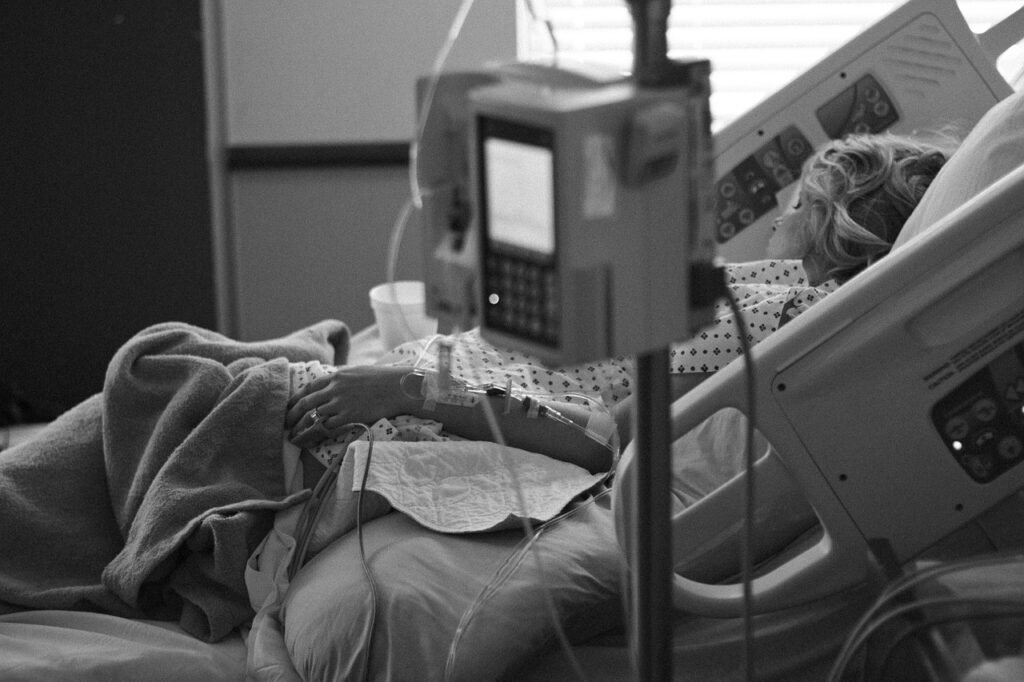
Even after I couldn’t cry any more, I couldn’t sleep. My back ached. My abdomen ached. I couldn’t move or I’d pull all the wires. But I could meditate. Yep, that’s what I needed.
I took three deep breaths, calmed myself, and began my zazen practice…
and something started gnawing on my arm. It hurt. Stinging? Yes, that was what the nurse had said. I would feel stinging. Mosquitoes. Okay, then.
Breathe.
Zazen helped for awhile. Then I just stared out the window at the night sky. I don’t know how long I lay there, it was a couple of hours, I think. Then, instead of mosquitoes, it seemed like there was an animal on my arm and it was taking really big bites. My hand went numb.
I wondered if the Germans had used this IV potassium system as a torture method in World War 2.
Suddenly, the alarm on the IV pump started, the potassium bag was empty. I perked up. Could it be over? Please let it be over!
The nurse and her aide came in. Nope, they said, I needed three more bags.
“Noooo!” I wailed. “Please, no. I can’t do this.”
They looked at each other. The nurse’s aide spoke up. “If you don’t do this, you can’t go home tomorrow.”
I didn’t care. I’d had enough. I was done with all this! Done with the wire and IV tethers that, in addition to the pain, kept me from moving into a comfortable position. Done with the ugly wild animal gnawing on my arm. DONE!
The nurse frowned. “It might be possible for you to have oral potassium. I could check with the doctor. But it will take longer than the injectable. Is this what you want to do?”
I nodded, put on the most pleasant face I could muster and whispered. “Please, yes.”
She left. A few minutes later she came back and unhooked the IV fluids from the catheter, handed me a cup of little white pills, and waited for me to swallow them all. “We’ll give you another dose in four hours. Your blood will be pulled right after that dose and so the last dose won’t show up on the morning lab report. So please let the lab worker know that you’ll need another poke after your last dose. I’ll try to catch them and tell them myself, but sometimes I can’t. You can always tell them to come find me and I’ll fill them in on what we’re doing.”
I agreed. It sounded like a reasonable plan.
The next four hours went by rather quickly. I was able to get in a little snooze; it seemed the staff took pity on me and scheduled my vitals rounds farther apart. The phlebotomist came in for my blood draw on schedule and I relayed the Plan.
I had my final dose of pills. Everything seemed to be going well.
The doctor came in and seemed surprised I was still there. He reassured me that they would release me today if everything looked good on the labs and then left quickly.
Breakfast was a piece of toast and a bowl of oatmeal. I ate the toast. Didn’t manage to get down much of the oatmeal.
But after a yummy stir-fry lunch, my husband and I tried contacting my case worker to see if we could get the home equipment sent up to the room, just in case my discharge was delayed past 5:00 again. We still planned on going home before the day was over. She said she’d see what she could do.
The nurses avoided coming into my room. Their lack of attention was noticeable. Finally, I asked to speak to the nurse with whom I’d been working for the last couple of days. I asked her what was going on with the discharge.
Her companion, however, another nurse or maybe an assistant– whom I never met prior to that moment– interrupted. “We’ve put in a call to the doctor but they’re all in surgery. We have to wait for them to get out before they’ll look at your labs and decide if you can go home.”
I gave her my “I didn’t ask you” face, and looked directly at my nurse, the one who had kindly prepared all my discharge paperwork in advance and had been extremely helpful for the past 3 days. “No one came in to take a second lab sample after my last potassium dose,” I pointed out. “How will they know if my potassium levels are normal?”
The other nurse/aide spoke up again. “They’ll use the labs they pulled this morning,” she began…
But this time I interrupted her, making it perfectly clear I wanted to discuss this with my nurse, not this rude woman who seemed to know it all.
“The night nurse told me that there would have to be a second test in order to catch the results from my last round of pills,” I explained. “Has that changed?”
Finally, finally! my nurse spoke up. It seemed her companion was going to let her get a word in after all. “We won’t need it,” she said.
My husband perked up. “So we’re just waiting for the doctor to get out of surgery? When will that be?”
Nurse Knowitall replied. “We don’t know. But when they get out they’ll see our message.”
My nurse nodded. “We can’t call them direct. But I’ve already left a message for them to contact me when they’re available. Then it’s just a matter of getting their approval for discharge.” She cocked her head sympathetically. “You know we already have the paperwork done, I did it all yesterday, all we have to do is press a button and print it….”
I nodded. My husband inquired about the home equipment, which set off another round of useless platitudes from Nurse Knowitall. Finally, my nurse promised to look into it and they left.
My husband spent the entire afternoon trying to get some answers. Around 3pm the discharge paperwork was brought in. My third (and final) catheter was removed. I changed into my clothes. We waited impatiently, and eventually the home health equipment was brought to the room.
Then we had to wait for transportation to bring a wheel chair. But eventually I found myself sitting at the hospital entrance, outside for the first time in over a week. It was a typical, hot summer evening in Tennessee, the air heavy with car exhaust and dust. I waited for my husband to bring the truck around. I was finally going home!

originally posted at annettezimmerman.com