Today I had my first post-operative appointment, which was supposed to be for suture removal and port placement. It ended up being just the suture removal. I’m not sure why, but the office wasn’t prepared to put me under anesthesia to place the port. So I have to wait for them to call and reschedule another appointment for that. I’m not sure if it will delay the chemotherapy, either, because I’m scheduled to go in and get that started next Tuesday. Looks like treatment is off with a bang!
Did it hurt to get the staples out? A little. The incision is 6 or 7 inches long and crosses vertically over my belly button. When the PA cut and removed the stables, it stung more than hurt. The incision is a little inflamed so I have to take antibiotics for the next week. Other than that, we discussed increasing activity levels (YAY! I can walk go for a walk!) and a 6 week limit on lifting things, longer until I can do any abdominal exercises. All in all, it wasn’t too terrible.
But now that I’m home I’m exhausted. We were gone about 3.5 hours and it was a long time to remain vertical. My abs are still weak. So I thought I’d do a quick review of the planner I bought for my chemo treatments.
After reading about other people’s experiences with chemotherapy, starting a planner/journal specifically for my treatment seems like a really good idea. I’m a fan of bullet journals and for a short time thought maybe I could create a treatment planner from scratch. If it weren’t a lot of work, I’m sure it would be easy. But, other than a medication list and appointment log, I wasn’t sure what to create in a planner. And there weren’t many templates online to use as an example.
So, like most of the U.S. (or maybe the modern world?) I turned to Amazon. I found a variety of planners there priced from $10 to $50. None of them had any serious images or reviews to help me decide what would work. I hesitated to spend a lot of money on it – after all, it’s just a planner, wouldn’t a simple school notebook be enough?
Then I found the CanPlan. I passed over it for a couple of days whilst considering other options, but I kept coming back to the need for something that was 1)preprinted sections for planning/journaling that I had no idea I’d need. I wanted a journal made by someone who had gone through chemotherapy and knew what would be helpful.
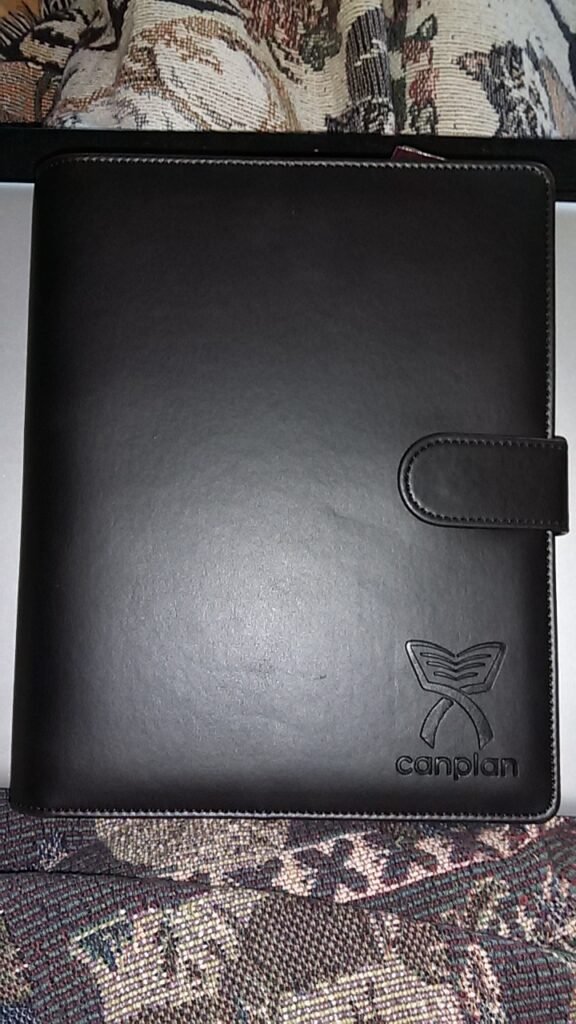
The CanPlan definitely filled those requirements, and also came in a very sturdy office-planner type binder. If it was like the office planner I used for work, I knew it would be tough enough to withstand a lot of traveling through doctor’s offices and outpatient clinics. The price tag was what was stopping me from buying it: a hefty $47! Was it really worth that much?
Still, I couldn’t find anything else remotely close to the same quality and with the same level of detail. With an Amazon 10% discount coupon, and using some of my points, I was able to get the cost down to under $27. So I bought it. And I’m glad I did!
Let me start the review by saying this: if you know someone who was recently diagnosed with cancer and will be undergoing a long treatment plan, ask them if they have a journal. If they don’t, consider buying the CanPlan as a gift for them. No one from CanPlan is paying me to say that – it really is a good planner.
The cover is bound with a leather-like material and has a magnetic closure. Inside both the back and front covers are pockets for receipts, business cards, and preprinted info that you get at appointments. There’s also a thick loop for holding a pen, very convenient when you don’t want to carry a purse or constantly ask for a writing tool.
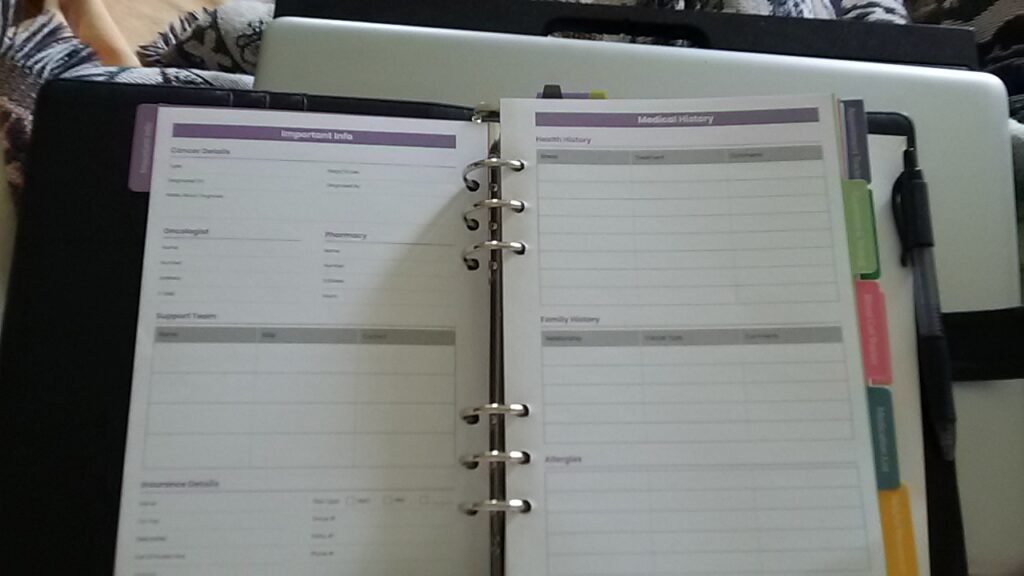
The planner comes with a set of tabbed, color-coded dividers, making it easy to find the sections you want to write in. I’m not going to go through all the sections, but I’ll show you some of the ones I think are going to be most helpful.
Treatment and Testing
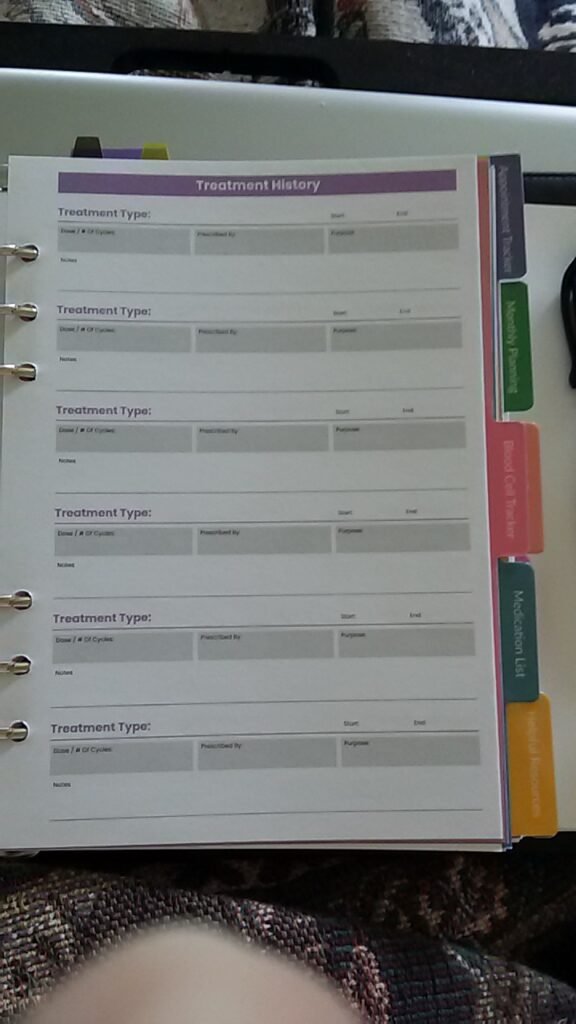
These pages have lines for recording your treatment types, including the dosage, number of cycles, prescribing doctor, start and end dates, and a line for notes. When you’re having a conversation with your support team about your treatment plan, this will be handy to refer to.
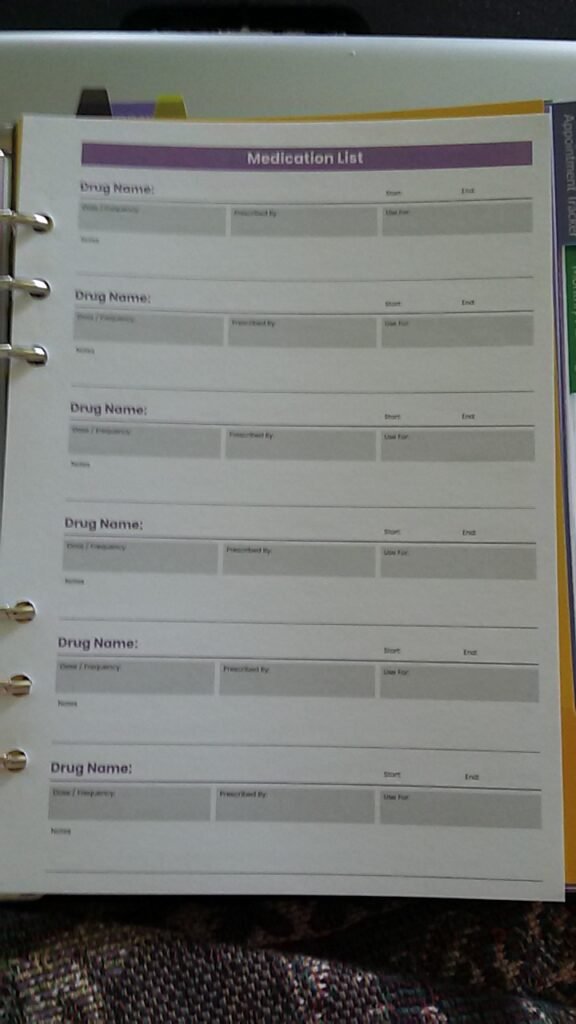
Medication List
I see this section being used a lot by me. It has lines for recording the drugs you are taking, start and end dates, the dose and frequency, prescribing doctor, and why you are taking it. I think this will come in handy if I want to recall a specific med for a refill request, or if I have to go to a new office and they want a list of all the meds I’m currently taking.
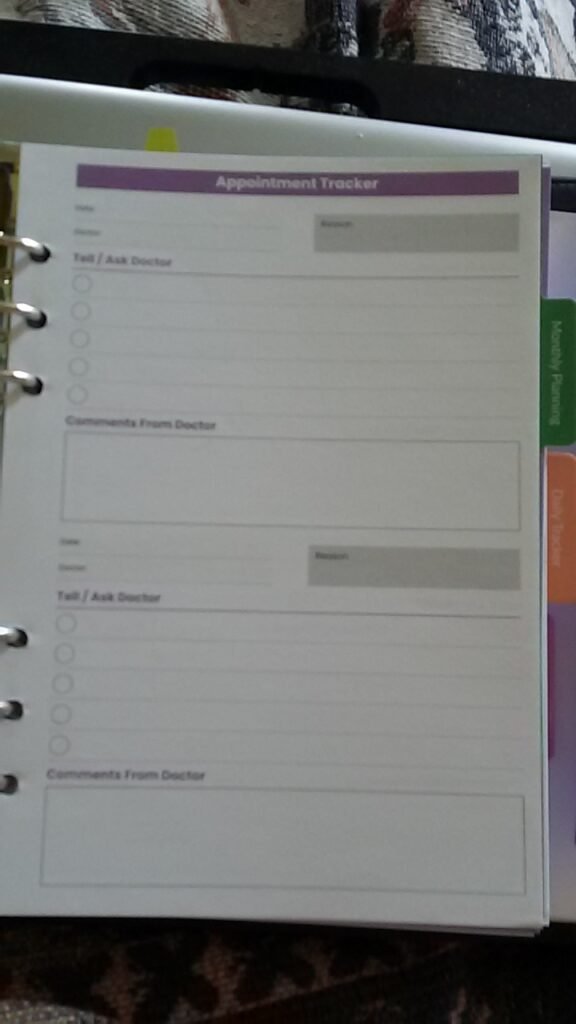
Appointment Tracker
This section came in handy today. I like that there are lines in this section for writing down questions I want to ask the doctor. That way I don’t have to remember them when we’re in the middle of a visit and the conversation goes off in another direction. There is also a box for recording the doctor’s comments. Very handy.
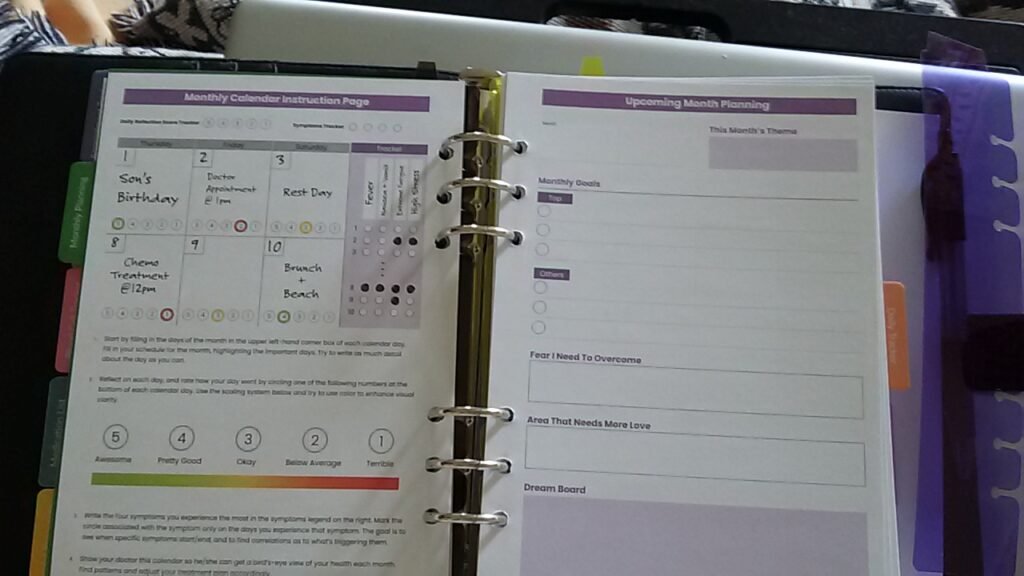
Monthly Planning
This section has several parts. There’s a page for the Upcoming Month Planning which includes monthly goals, fears to overcome, areas that need more love, and a “dream board”. Then there are two pages for the calendar month, on which you can put appointments and reminders. There’s also a daily mood tracker and a symptom tracker, so you can simply circle a number to keep track of how you feel or what symptoms you are experiencing. These are used for determining how well you are handling the therapy. THe last part of this section is an end of the month review, on which you take stock of your overall health during the month for reflection and possibly further action.
Daily Tracker
There is also a daily tracker, which has places to record the day’s top tasks, medications, symptoms, hours of sleep, physical activity, diet and inspirational/motivational messages.
The journal also has sections for personal information, diagnosis and bloodwork information, notes, and a whole section dedicated to “Positivity Exercises”. These are fun little things you can do while waiting for an appointment, including a smiling experiment, a couple of pages on which you can write messages to God, and a Bucket List. It’s cute and definitely intended to help you remember that there are reasons to keep going!
The only drawback that I see with this journal is that it’s a wee bit heavy. But if you want to make it a little lighter, you could take out half of the monthly planning sections and set them aside until you needed them. I haven’t weighed it, but I’d guess it’s somewhere around 3 pounds, definitely more than a can of beans but less than a gallon of milk. The cover is roughly 8 x 9.25 inches (including the magnetic flap) so it’s not a small book. The pages inside are A5 size.
I think the CanPlan is going to be very helpful for recording the myriads of little details I’ll need to know for my chemo treatment. If you or someone you love is in need of a planner, you might want to consider it. I’ll try to remember writing a follow-up post after I’ve used it for a couple of months to let you know if it really was a good purchase. Hmmm…I guess I should put a reminder for that in the new CanPlan, shouldn’t I? 😉
originally posted at annettezimmerman.com