Way back in 1999 or so, I earnestly began studying Buddhism. I’d had both of my children by then, they were little boys, and I think childbirth brought a lot of undefined fears to the forefront of my mind. I remember the first plane trip we took them on…I’d never been afraid of flying before, but that flight was absolute torture because all I could think of was that our plane would crash and my little boys would die. Or I’d be incapacitated and couldn’t take care of them.
These thoughts and feelings didn’t go away. Everything I did was for the safety of my children, from researching and buying organic foods to using natural cleaning products to increasing our physical activity so that we’d be healthy and happy. The fear of death was very strong. What do people with a strong fear of death usually do? They turn to religion for answers, of course. And so did I.
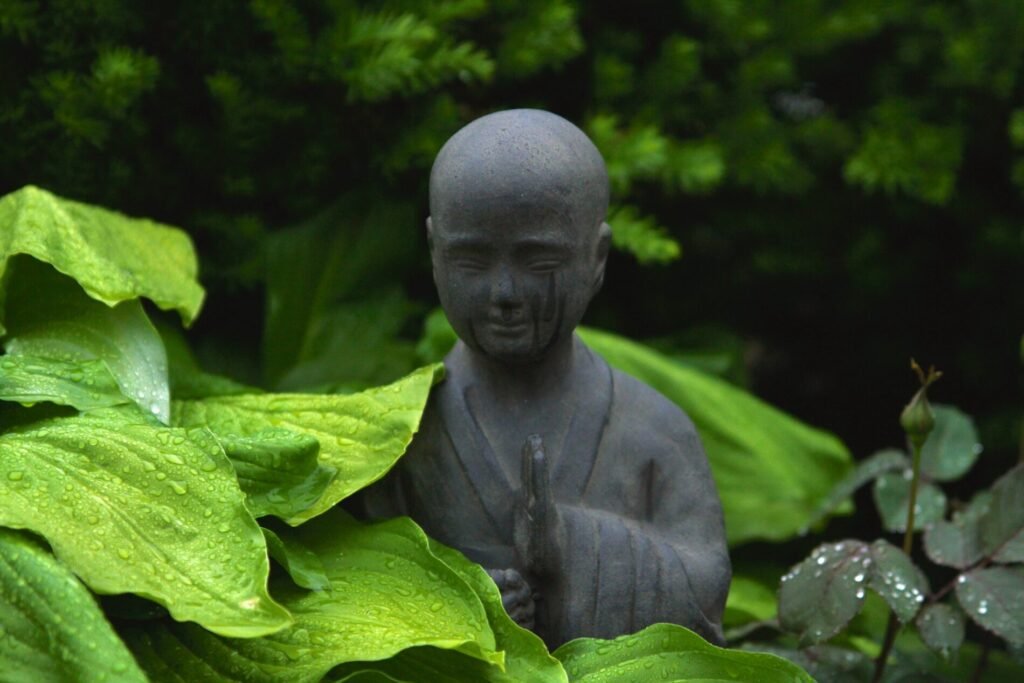
We joined the local Unitarian Universalist church. I thought it would be an excellent place for my boys to learn about all kinds of religions so that they could make a good choice someday about what they wanted for their faith. I learned a lot and developed a very deep respect for the true faiths of Judaism, Hinduism, Islam, and Christianity – both Protestant and Catholic, as well as a few very large North American offshoots. But the belief system that I could most identify with was Buddhism.
Although some forms of Buddhism have a faith component, it relies mostly on personal experience for verity. You can study Buddhism to the nth degree and achieve a level of intellectual understanding, but to really believe the tenets of the philosophy you have to experience them yourself. And when you do, you intrinsically know these truths. The only analogy I can give is putting you hand under a flow of water. You can read all about what it feels like to others, but until you put your hand in the water you’ll never know for sure what it feels like to you.
That’s the way Buddhism works.
Back to my story…My first explorations focused on Theravada Buddhism because it seemed like the oldest branch and, well, everyone knows that anything ancient is less likely to be altered and more true to the original ideas, right? Yeah, well in hindsight this seems like a stupid rational for making a decision, but I was trying to be logical about my choices at the time.
I studied canon (that’s a fancy word for religious texts), learned various methods of meditating, and began following the eight-fold path. That’s a way of living in alignment with a set of moral rules, kind of like following the Ten Commandments. I became vegetarian in September 2000 – to the dismay of the rest of my family, who still eats red meat and poultry to this day (although they are happy with less of it).
The church often invited Soto Zen monks from Shasta Abbey to give talks and meditation sessions. At that time, I didn’t think much of Soto Zen because their primary path to enlightenment was, well, just sitting. Rinzai Zen, on the other hand, involved all those delicious intellectual koans…just the kind of thing that appealed to a logical person like myself.
So I can kind of say that I followed more of a Zen path since, oh, the mid to late 2000s. When we retired and moved to Tennessee, I started seriously exploring Zen. I read all of The Three Pillars of Zen at least twice through, then read parts of it even more. I then went through an entire list of recommended reading from the website of the Mountains and River Zen Monastery. I studied koans. I focused on zazen instead of other types of meditation practices.
And somewhere along the way, things clicked. Rinzai wasn’t important anymore. Zazen was! My mind seemed clearer. I could see what was important without being blinded by expectations. I started focusing more on Soto Zen practices. I read Brad Warner’s first book, then subscribed to his YouTube channel and the Los Angeles Zen Center podcasts. I read both of Charlotte Joko Beck’s books over and over, and still read parts of it after meditating sometimes.
I feel like I’ve found a home in Soto Zen. My experience with Zazen has helped me to understand the teachings of Dogen. Dogen was both wise enough to record his insights into Zen and unwise enough to record his insights into Zen. I say this because no one can understand anything in the exact same way as somebody else – understandings always rely on your own education and past experience for interpretation. So Dogen can only give you his experience, and you have to take from that whatever you can in order to go down your own path, hoping that you aren’t taking his writings out of context so far that you miss the path you intended.
I no longer fear death as much. When I was diagnosed with cancer in June 2021, and went through a horrible two months of pain and suffering before the chemotherapy was tailored to my body, I was confronted head-on with death. I found out that it wasn’t scary after all. There were a couple of times during my ordeal that I welcomed it, thinking that it was an escape from what I was going through. But I didn’t pursue it. I had my family to think of. It would’ve been very selfish to decide on suicide, and that’s what actually stopped me.
I’ve also been able to let go of multitudes of expectations. It’s extremely freeing. People are who they are, and it’s ok. Events don’t turn out the way you plan and it’s ok. Life goes on through climate change and the world won’t end. Change is life. That’s the biggest expectation that has to be let go if you want to have more happiness in your life: change is going to happen, you can’t expect things to remain the same without some kind of suffering. The best you can do is try to balance the good with the bad.
Which brings me to the biggest discovery of all in my life’s journey: it’s all about this balancing act.
I think that’s a good place to end for now.