This week was full of breakthroughs and visions.
I’ll have to take you through them the long way, though. If I just set it out plainly it probably won’t make much sense and might even sound a bit ludicrous.
So here we go.
Community
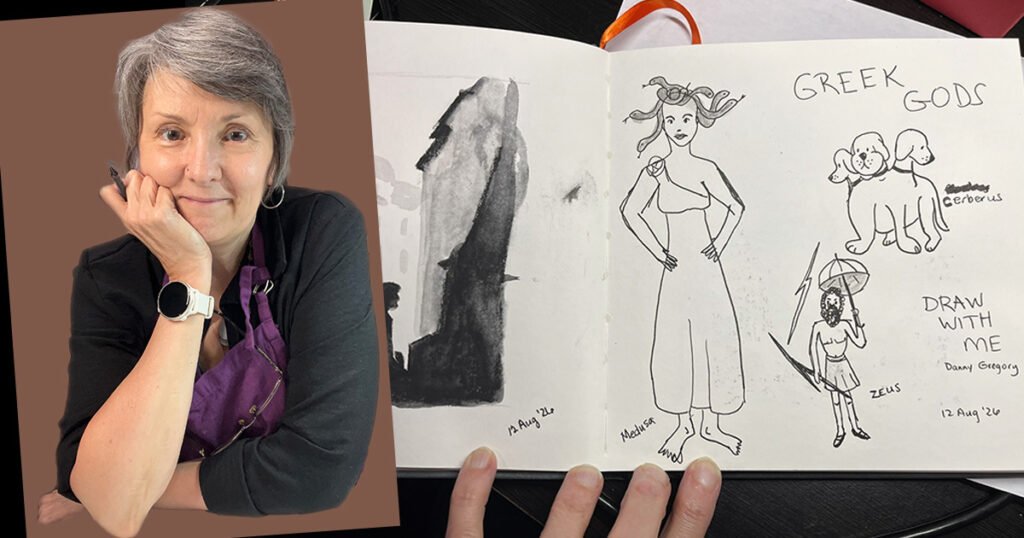
I signed up for a workshop called “Sketchbook Revival”. It’s hosted by Karen Abend and about 20 other artists and runs until May 4. The objective is to focus on creating a daily sketchbook habit. But already I’m finding that there are some additional benefits that I didn’t anticipate.
The first is that I’m enjoying a couple of hours a day listening to and following along with these artists as they share ideas for filling a sketchbook. When I signed up, I envisioned I’d receive daily prompts in my inbox. Perhaps links to a video or written prompt, or perhaps an email explaining a prompt, such as “draw a bird” or “draw the first thing you thought of when you woke up this morning”.
I do get a daily email, but it includes 2 links to Vimeo videos, and each video has featured Karen interviewing an artist. Each artist has talked about how they work art into their daily lives as well as given inspirational lessons or tips on how to use what they’ve learned. Some of lessons touch my spirit, some of them are very practical.
I never expected this workshop, which is free, to offer so much high quality, valuable content. Many people would pay a lot of money to have this. And that’s just one side of the workshop, the part where I’m receiving information passively. That part was expected. The second part was not.
The workshop also has a closed Facebook group. This is where we post our artwork and comment on other people’s posts. It’s a very active group. My surprise is that I feel like a part of a big community here. There are over 5000 members in this group, but it feels like I’m part of a face-to-face class. It’s encouraging to see so many people who have an interest in expressing their creativity.
I belong to other Facebook groups, of course, where we share our artwork and receive critiques or pats on the back. But this group is really lively. Maybe because it’s not forever? Or because we just started? Or maybe it’s because it revolves around a shared activity. I’m guessing it’s a combination of all these things, but it works.
I find myself enjoying this community. I’m not a terribly social person, but this was completely unexpected. I didn’t realize how much I was missing by not being part of an art community. It is very welcome. And I don’t even have to leave home!
How did I not see this before?
Communication
The next breakthrough this week came while I was listening to the Creative Pep Talk podcast.
It’s hosted by Andy J. Miller (Andy Pizza), a very practical and down-to-earth guy. I haven’t been listening to it for very long, having accidentally stumbled onto it while searching for something to listen to while working out. What I’ve heard so far has been interesting enough to keep listening.
Until yesterday.
This week’s podcast was about making art based on what other people wanted instead of your creative muse. I’ve heard this before from people who are basically entrepeneurs who use art as a means of making money. This was the first time I heard it expressed a little differently. Basically, the message was “it’s great if you create art based on whatever you feel like creating. It’s great to do that if it gives you satisfaction. But you aren’t going to be part of a community that way”.
Andy explained that, if you were an ice cream maker and you enjoyed creating your own ice creams, you might create a new ice cream flavor every day based on how you felt when you woke up. Then you sold only THAT ice cream flavor that day. Every day you’d have a new flavor, but the flavor would be unpredictable because you wouldn’t know until that morning what flavor you would be creating.
So this might attract some people to the shop, since it’s a novelty. But for the people who go to your shop because they liked a specific flavor, it would be a killjoy. He offers another example: you go to your favorite coffee shop because you like their scones. What if you walked in one day and they didn’t have any of those particular scones? Not only that, but when you told them “I come here just for those scones!” they say “well, we didn’t feel like offering them. Have one of these cookies instead.”
He doesn’t say it like that, but you get the idea. His point was that you aren’t going to build a business by offering only the things you want and not anything the public wants.
My take on this (coming immediately after the realization about community) is that you can’t be part of a community if all you are going to do is “your own thing”. I enjoy being part of a Facebook group that shares our colored pencil drawings or beginner sketchbook art, but all we are doing is posting pictures for other people to see. I suppose there is a possibility that someone will ask a question or provide some inspiration, but no real conversation takes place.
As a result, I’ve concluded that, while my blogs about my independent illustration study is fun and helpful to me, it’s all one-sided. I didn’t think I’d miss an aspect that is part of a real-world class but not part of my independent study: communication. But this week I found out that I do miss it.
Here’s the breakthrough.
Art IS communication. The motivation may be spiritual or emotional or something else that’s personal. But Art is a way to get what is on the inside to the outside (thank you Shelly Klammer for putting this into words in our lesson yesterday), and therefore it is communication. And effective communication involves the process of giving and receiving.
So am I missing out on something?
I’ve deleted my illustration study posts. They were actually really boring.
Inspiration
As a side note, sometimes I do get pings in my inbox when somebody likes a post on the blog. Most of the time I don’t pay much attention to them. The reason for this is because I occasionally come across a blog that I like because it’s well written, or it has a good message, or I like the picture, etc. It doesn’t necessarily mean I like all the content in that website, nor does it mean that I think the blogger would like my website.
But I hit the “like” button anyway, and sometimes I leave a comment about what I liked. Hitting the “like” button will produce an email in their inbox that says something like “Anni liked your post. Maybe you’ll like hers. Go see what she’s writing about.” I don’t know, maybe they would like something I wrote. But for people like me, who don’t appreciate bots analyzing my habits, it’s a surefire way to get me to NOT click into their blog. Why?
Because this is also a tactic used by people who just want to get traffic to their site. They don’t care what blogs they are “liking”; they hit “like” because they know you’ll get that little email and click back to their blog. They aren’t subscribing to yours and possibly will never visit your blog again. But chances are you’ll go visit their blog at least once. Maybe you’ll feel like you “owe” it to them to subscribe because they liked your blog first.
Whatever.
Normally, the only time I click back to see who liked my post is when they leave a comment. Because then I know they actually READ something, or looked at the pictures, or in some way made a connection.
So now I have a dilemma. I just went through an entire revamp of Still ‘round the corner. But it needs more work. I see direction. I see a path for developing a community of creatives who want to be part of a community.
But how do I get there?
I was reading BrainPickings with my morning coffee when I stumbled across this article:
https://www.brainpickings.org/2016/10/21/lao-tzu-tao-te-ching-ursula-k-le-guin/
Take a minute right now to go read it. I’ll wait.
So what did you think? I love the Tao te Ching. If Alan Watts were alive today, I’d, at the very least, be following his blog. I find so much of my personal philosophy in the Tao that it defines (or really attempts to define) my existence.
And I love what Ursala Le Guin did with it. She used it to communicate her own perspective about life, the universe, and everything.
What if I did this?
The Tao isn’t (physically) a large book. What makes it large is all the thought that comes from reading it. Every reader has their own set of unique experiences and insight that filters the words into personal messages. And Creatives possess a skill set that lets them express their understanding, the message that they received, in a way that can be communicated without words.
Which is what the Tao is about: trying to express what can’t be put into words.
What if this became a community Project?
Imagine a community of creatives, each selecting a chapter of the Tao that speaks to them, and communicating their thoughts about their selection through a piece of artwork.
What would it look like?