I miss Mr. Rogers.
I loved the television program, of course, but I miss the feeling of the world he created. A world where people paid attention to one another, curiosity was welcome, making things was worth watching, and gentleness was never treated as weakness.
One of the earliest things I remember is his house. It was simple: a sofa, a bench near the trolley, Picture Picture, the fish tank, and the kitchen. It reminded me of my Nana’s house. I knew where everything was, and it was comfortable. I knew where I could go and where I couldn’t.
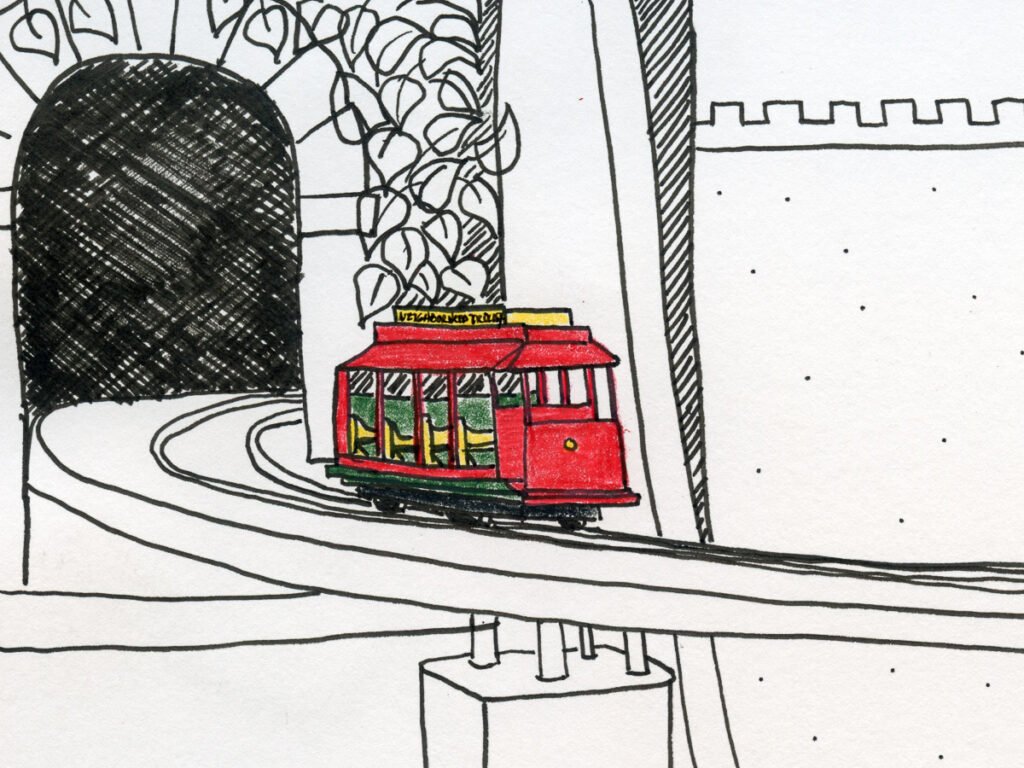
Then the trolley would leave the house and travel to the Neighborhood of Make-Believe. I always wanted to ride in one of those little seats. I wanted to find out where it went when it disappeared. The journey was never explained, which bothered me a little, but mostly it made me curious. Where did the trolley go in between? What happened in that invisible space between the house and the neighborhood? I never got to find out, but I still like the question.
Soft jazz was another important influence. I loved the quiet, wordless music that played in the background. It was interesting without demanding an explanation. It created an atmosphere without telling me exactly what to feel.
Sometimes I still listen to soft jazz when I’m creating. The wordless music helps me focus. Other times, it gives my thoughts somewhere to wander while my hands are busy.
Mr. Rogers also made curiosity feel like a good thing. There were a lot of questions I was not allowed to ask at home, but I never felt that curiosity itself was wrong. I remember exploring the neighborhoods where I lived and sometimes go places I probably wasn’t supposed to go. I didn’t tell any grown-up where I had been. I simply went to see what was there.
I was a shy child, but I was observant. I wanted to know how things worked and how they were made. Mr. Rogers helped make those questions feel ordinary and worthwhile. It was okay to ask, “How was this made?” It was okay to look closely. It was okay to be interested in the world. That may have been one of the earliest influences on my creative life.
The first piece of art I remember actually making was a construction-paper black cat in kindergarten. I was incredibly proud of it and gave it to my Nana. I think it may have been the first time anyone had taught me how to use art materials to make something.
Before that, I had crayons and paper, but I don’t remember making anything specific. I think he helped make creativity feel acceptable. Making things wasn’t frivolous. Nor was curiousity. A child could watch someone build a model, visit a factory, play music, or work with their hands and understand the process without being treated like they were stupid.
Kindness was another lesson that stayed with me. To me, kindness means not judging – not judging other people, and not judging yourself. I still believe that, and I still try to live according to it.
I was naturally kind to other people, and it was reinforced by my Nana, who was a strict Baptist. But at school or at home, it was considered weak to be nice. In Mr. Rogers’ world, it wasn’t something embarrassing. It was simply part of being a person. A shy, curious, gentle child could exist there without needing to become louder, tougher, or more assertive in order to belong.
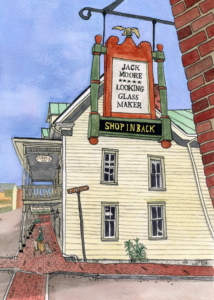
I’m still learning how to offer that same acceptance to myself. This has become especially important in my artwork. I’ve spent a great deal of time trying to make realistic paintings, mostly because I admire that kind of painting, and I think it can be beautiful. But I don’t think I will ever have a painterly style. For a long time, that felt like a deficiency.
Now I’m beginning to understand that my work has its own qualities. It has quirks. It simplifies things. It notices certain details and ignores others. It doesn’t always behave itself.
Quirks are beautiful. A perfectly realistic painting can be beautiful, but sometimes it feels to me as though it has no life because it has no quirks. The irregularities, odd choices, and unexpected marks are part of what makes something real.
Perhaps kindness means allowing my art to be what it is, too. Mr. Rogers didn’t teach me a particular art technique. He didn’t hand me a paintbrush and show me how to mix a color. His influence was quieter than that. He helped create a world in which curiosity was safe, creativity was worthwhile, gentleness had value, and people weren’t judged into becoming acceptable.
Those ideas have followed me for a very long time. They’re there when I put on soft jazz and draw. They’re there when I wonder how something was made or when I look at a strange little mark in a painting and decide it might be worth keeping.
I miss Mr. Rogers, but his influence is still with me.