This month I’ve been doing a lot of exploratory work in my sketchbook. I wanted to use Sketches and Scrubs’ Sketch Season as a springboard for figuring out what to focus on in my own art. It’s a hundred-day project that encourages participants to dedicate time to their art, with prompts and guidance offered as a menu. What to investigate is up to each person.
I chose to start by exploring why I’m drawn to certain kinds of line drawing, using Paul Hogarth’s work as a springboard. At first, I concentrated on copying his techniques. How did he make those marks? How did they become bark, foliage, or the surface of a building? I wrote a post about how I approached this study on my Patreon. But as I worked, I realized that the techniques were only part of what I wanted to understand. I already knew I loved making line drawings, and I could identify some of the qualities I admired in Hogarth’s work. What I hadn’t quite understood was how much of my enjoyment came from figuring things out.
That actually seemed worth investigating. It would help build my confidence, for sure. Also, when my creative work hits a lull, knowing what actually interests me might be more useful than hunting for another tutorial.
Looking at Hogarth’s drawings, the drama of the lines catches my attention first. His pictures ask me to interpret what I’m seeing. The marks suggest surfaces and shapes without describing every detail, and my eyes move around the drawing, following them. There’s life in that movement.
I don’t need color for this to happen. In my own experiments, color can complicate what I’m trying to understand. The tonal exercises helped me see how Hogarth’s marks create depth and shadow, but I’m also interested in how much a drawing can convey through line alone.
Perhaps those choices came naturally to Hogarth after years of practice. For me, they involve looking, analyzing, trying something, examining the result, and changing it. Then repeating the process until I’m satisfied, or at least until I understand what I want to try next.
And I think that process is a large part of what makes drawing enjoyable for me. My natural inclination to analyze gets an opportunity to participate in an activity I love. My engineering self and my artist self can work together.
Nine years ago, when I returned to creative drawing after a career in technical work, I didn’t recognize how those parts of me could fit together. I associated my technical abilities with precision: realistic proportions, accurate perspective, and faithfully representing what I saw. If I wanted to exercise that side of myself, I thought the drawing had to show it.
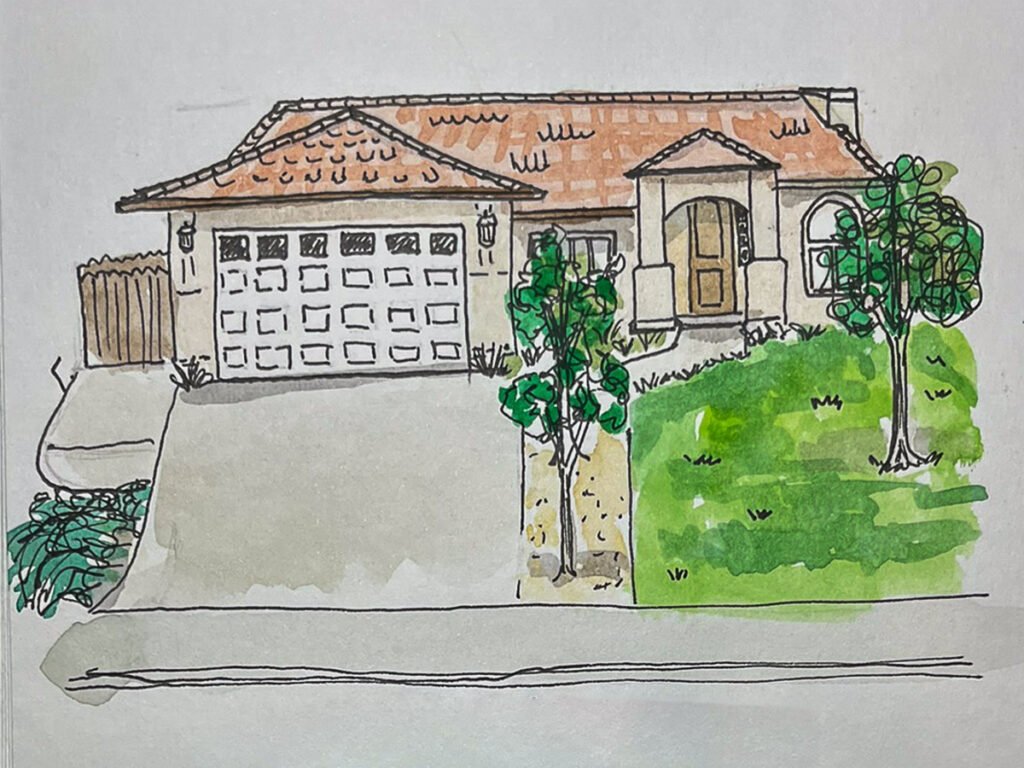
I could make realistic drawings, and I enjoyed developing the skills. But some of the results left me strangely unmoved. A portrait study might demonstrate that I could draw a face. An urban sketch might record a place I’d visited. I could appreciate the work I’d put into them without feeling curious about the pictures themselves. I wanted something more to happen on the page.
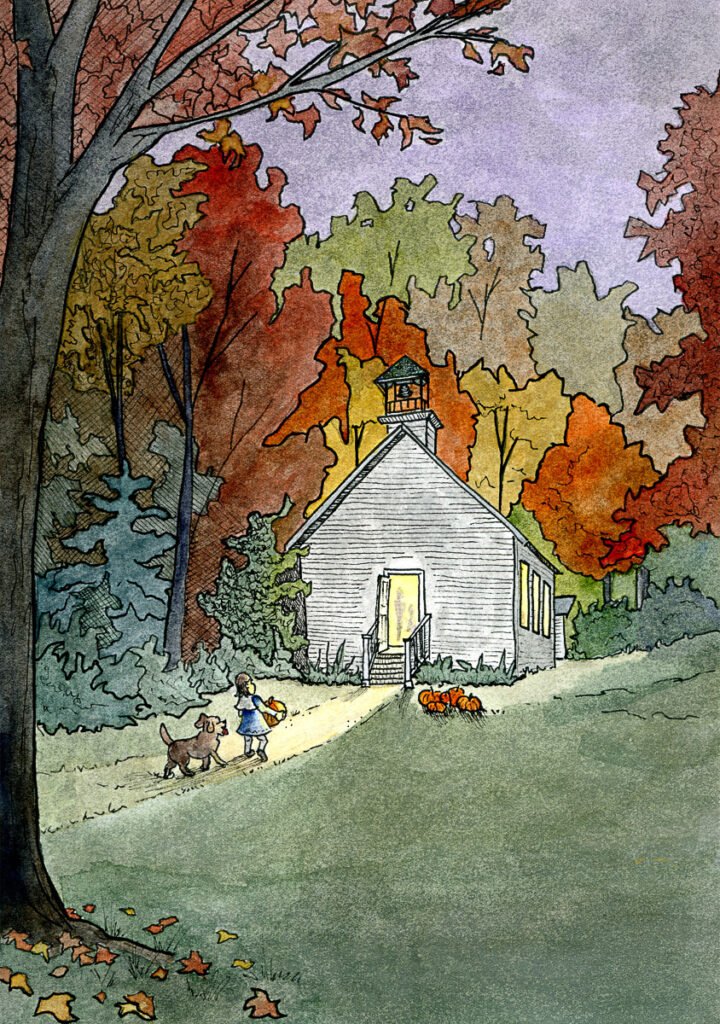
That helped me understand my attraction to illustrations in picture books and magazines. A good illustration contributes to the telling of a story. It might supply something the words leave unsaid, establish an atmosphere, or make me wonder what’s happening. Sometimes the picture tells the whole story by itself. Creating that kind of image involves analysis, too. What matters in this scene? What can be left out? Where should the eye go? What would make someone linger?
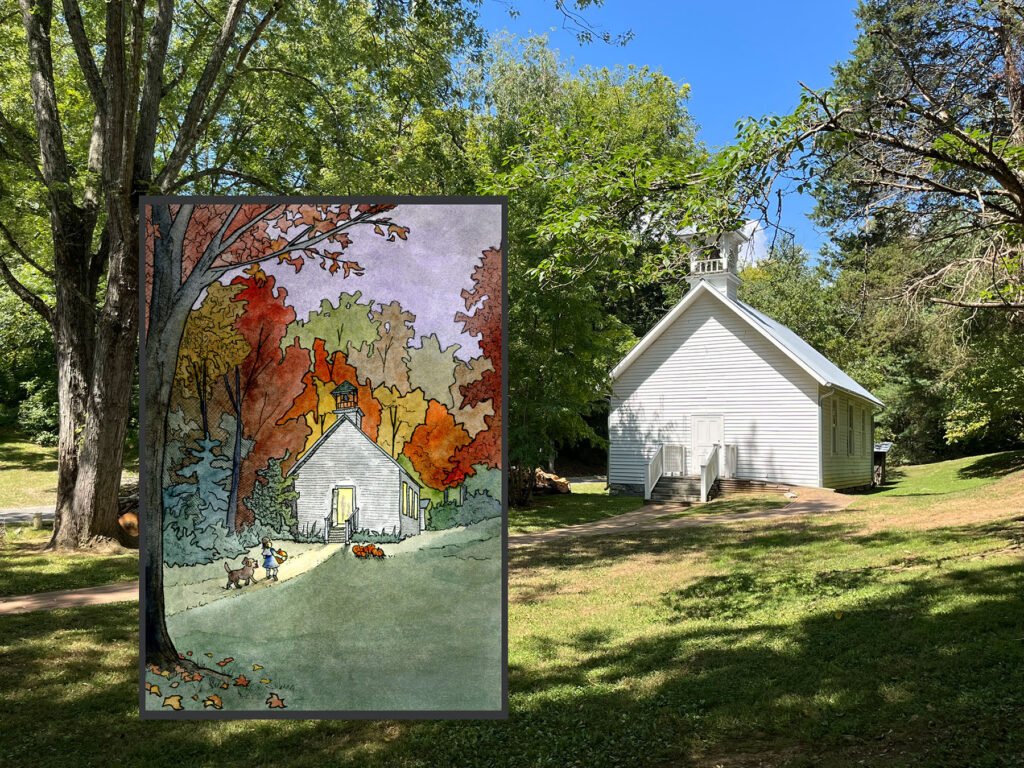
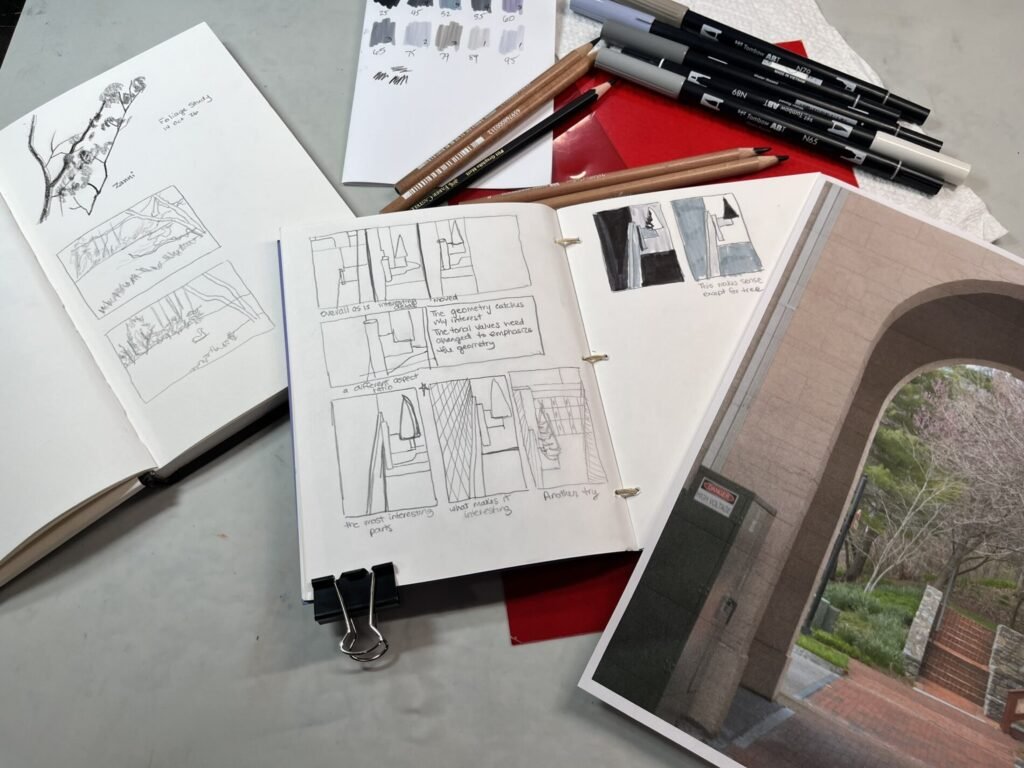
I’ve been asking similar questions while making prints of familiar places in Jonesborough. I like looking at what’s there and finding ways to make it more interesting. Recently, while experimenting with thumbnails of an urban scene, I kept noticing how oddly a tree sat among the geometric shapes of the buildings. I began testing compositions, then tonal arrangements of light and dark to bring out that quality. The choices needed to make visual sense while emphasizing what had caught my imagination.
The fun part was figuring it out.
The Hogarth studies have also helped me separate the qualities I admire from the materials I want to use. I love the look of his pencil drawings, but graphite is messier than I enjoy in a sketchbook, and I’m not getting the variety of line I can achieve with a pen. I want to keep exploring those lively marks but I’ll probably do it in ink instead.
Even though this exploration began before I joined Sketch Season, the timing was fortunate: the project reinforced my decision to study, experiment, and pay attention to what I discovered. Its recent focus on simplicity gave me a useful reason to return to thumbnails (which I always enjoy) and examine why I love them more closely.
I’m beginning to understand that finding my style includes recognizing how I enjoy working. Studying another artist’s technique gives me something to try. Analyzing the experience helps me decide what to keep, what to change, and where to go next.
I don’t want to return to a technical career. But I’m happy to find that the part of me that enjoyed investigating and solving problems still has useful work to do. There’s room for the engineer in my sketchbook. I think she’s enjoying herself.