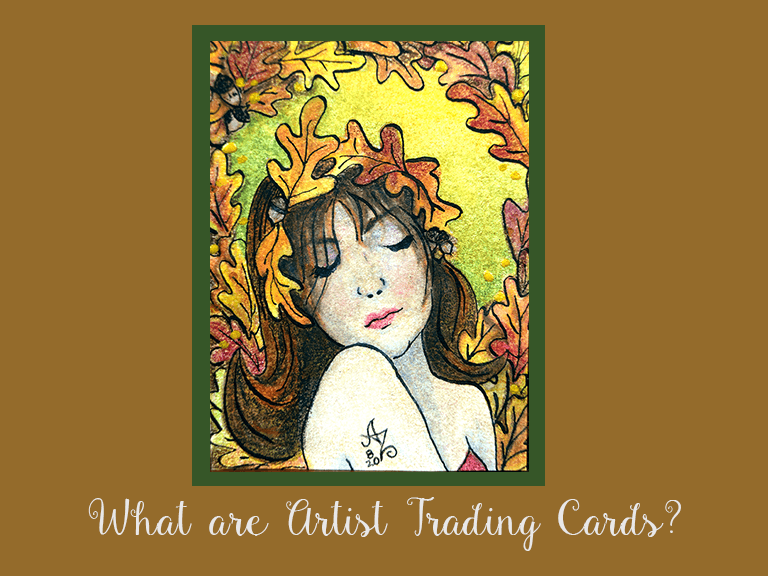
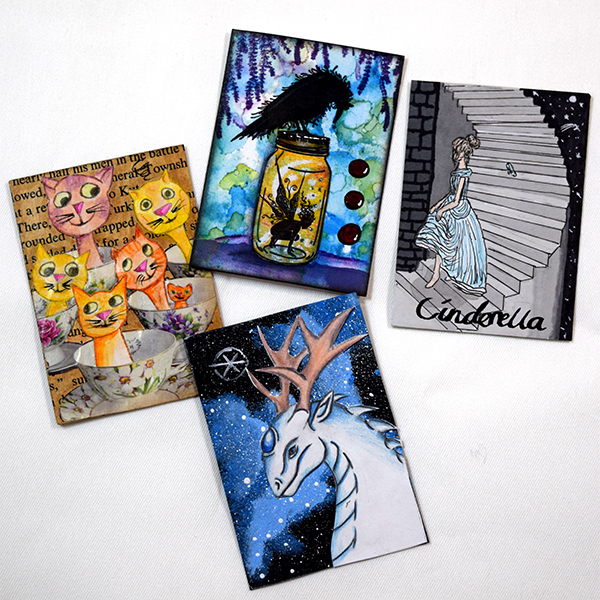
If you’ve seen my Instagram lately, you know that I’ve been focused on making “little” art: 2 1/2 by 3 1/2 inch cards created with watercolor, ink or colored pencil. These are Artist Trading Cards (ATC), a fun hobby I stumbled across in 2018 and have recently returned to. Today I thought it would be interesting to find out where this hobby originated. In a future post I will show you ways to make them.
How did the ATC craze get started?
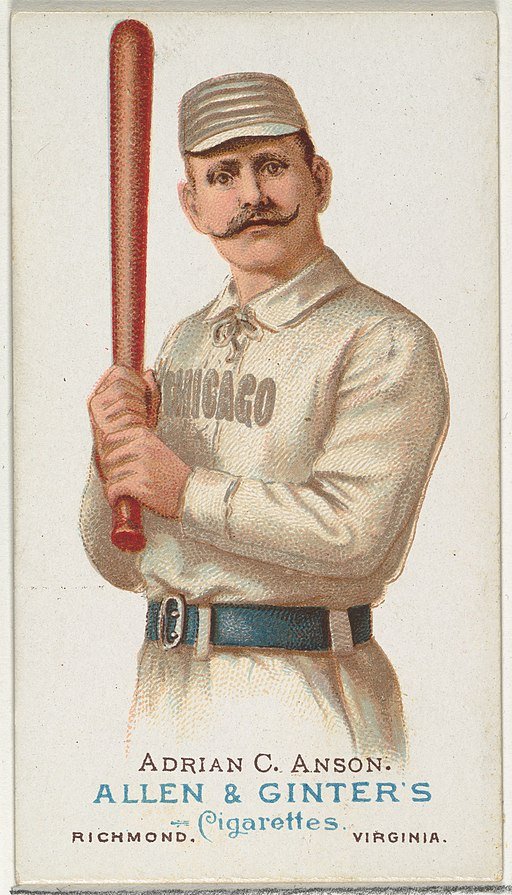
Trading cards have a long history. Back in the 1860s, when baseball was just starting to become popular, photography was becoming more affordable for the common person. A few baseball players had their photographs printed on small, wallet-sized cards to give to fans. The fans loved them, and some smart manufacturer who noticed their popularity decided that they would be great marketing tools. Cards were printed with baseball players on the front and product advertising on the back. For many years, they were commonly found in tobacco, candy, or ice cream products, novelties that were “luxury items” that people bought only when they had the money. The addition of a “free” baseball trading card was one way to encourage folks to spend more on these products.
When baseball became super popular in the early 20th century, trading cards became a popular hobby. But after the wars, manufacturers no longer needed to include trading cards to get people to buy products, and by 1950, they were being produced only by one chewing gum company. These were prized as collectibles and traded amongst the long-time collectors. Eventually, other sTports joined in the trading card craze, and packs of trading cards could be bought independently of chewing gum or other products. By the late 1980s, trading cards were well established in the personal hobby world.
So in 1988, when Manfred Stirnemann (M. Vänçi Stirnemann), an artist and hockey fan from Zurich, visited Calgary to participate in the Olympic Arts Festival, he was introduced to the world of hockey trading cards. He enjoyed collecting them so much that, in 1990 when he wanted to document his art work, he thought of creating the catalogue so that his art would look like hockey trading cards. The cost for printing such a project was too high, however, so he ended up shelving it until 1996, when he decided to make the cards by hand. The following year, he held an exhibition in Zurich to show off the 1200 cards that he’d created, asked attendees to bring their own cards, and wrapped up the show with a trading session. He and his friends enjoyed the session so much that they decided to make it a monthly event.
The Artist Trading Card was born.
What do you do with an ATC?
ATCs are traded freely amongst collectors or given out as promotional items. They are never sold. They are always miniature pieces of art signed and dated by the artist, and always sized at 2.5 by 3.5 inches. Whilst some artists create cards for sale, those are not ATC. They are called Artist Card Editions and Originals (ACEO), a term created by an E-bay seller in 2004 specifically to sell miniature artworks the size of trading cards.
How do I get started making my own ATC?
If you are interested in learning how to make or trade your own ATC, there are several forums online that make it easy.
ATCs For All is a website that hosts swaps, individual trades, and forum discussions. Visit the Welcome forum and read their instructions to get a good idea of what is expected from collectors and traders.
Search on Facebook for “Artist Trading Cards”. There are several groups that swap through the mail, each having different requirements.
Visit the official Artist Trading Card Calgary website. http://www.artisttradingcards.org You’ll find the “official” history on the home page (where I got most of my information), announcements about in-person shows, photos, and links to artist’s trading card sites.
Let me know if you decide to give it a try!
originally posted at annettezimmerman.com