I’ve lived near Jonesborough, Tennessee, for ten years. I love the beauty of the area, appreciate its history, and enjoy many of its traditions. Our house is comfortable, and I’ve made a life here. Yet I still don’t feel that I belong to this place.
That realization made me wonder what belonging actually means. Is it familiarity? Community? The freedom to move through a place without thinking about it? Is it something we recognize while it’s happening, or do we create it afterward through nostalgia?
To answer those questions, I began looking back at the places where I’ve lived and the few that truly felt like mine. I discovered that before I could understand why I don’t feel rooted here, I had to remember how I learned not to put down roots at all.
When I was five, my family moved back to Findlay, Ohio, the city where I was born. We’d been living in Atlanta for a year, and we returned just after Easter. At first, we lived in a large two-story house on Gayle Lane. It was temporary, although temporary was already becoming a familiar condition.
My grandfather owned a construction business, and he was happy to have us back in town. He gave my father a job building houses. Eventually, my parents found an old fixer-upper on Bennett Street, and my grandfather let my father repair it. I have many stories about my six-year-old self “helping” with that project. I’m uncertain whether my father would have used the same word.
When we moved into the house on Bennett Street, it was ours. We lived there for three years, and it was home. By the time we left, I knew how to get to nearly every place that mattered to me. I knew the route to the playground, the public swimming pool, my school, and my Nana’s house. I knew where the county fair was held and how to get to the shopping mall. I knew the way to the restaurants Nana took us to—the Dutch Pantry, the L&K, Britt’s café counter, and Wilson’s. From her house, I knew how to reach downtown, the movie theater, and McDonald’s. I even knew the way from Findlay to Fostoria, where my other grandmother lived.
I understood the shape of my world. I knew where I was and how things worked. Findlay belonged to me, and somehow I felt that I belonged to Findlay in return.
Then we moved, and moved again, and again. I’ve made a spreadsheet of every place I lived before I left home at nineteen because I didn’t want to forget the addresses. There were enough of them to require a spreadsheet, which probably tells you most of what you need to know.
The houses themselves rarely mattered much after Findlay. They were places where I happened to live. If I could make one look nicer, that was good. If I couldn’t, it wasn’t a great loss. None of it was permanent anyway. But there was one other place during those years that felt like mine. When I was in ninth grade, we lived in Grove City. We were there for only about fifteen months and lived in two different houses, so permanence wasn’t what made me feel attached to it.
It was freedom. I knew the streets. I knew a lot of people. For the first time, I felt genuinely independent. I could walk out the front door and go downtown whenever I wanted without asking permission or finding someone to drive me.
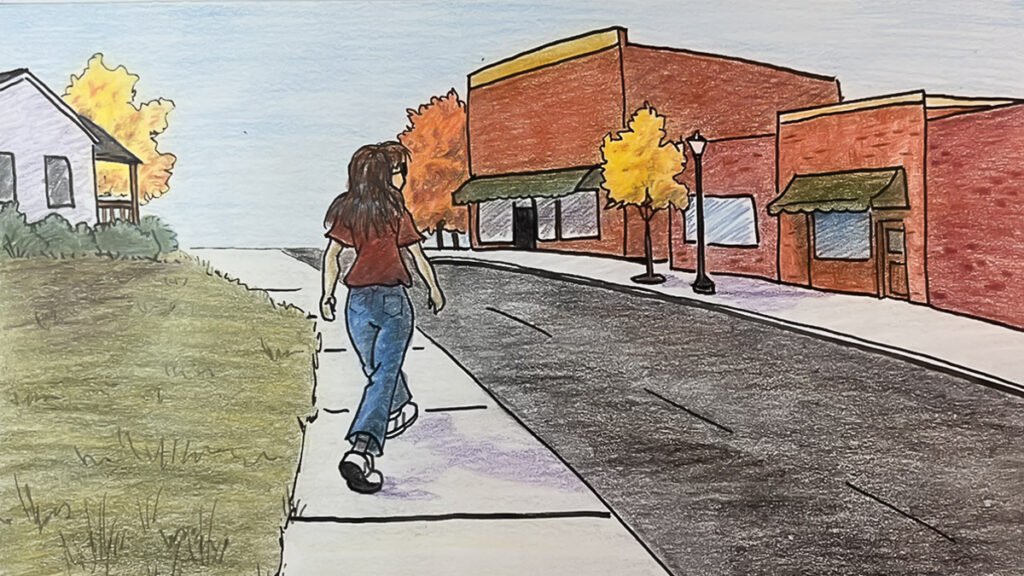
That freedom helped me make the town my own. I wasn’t merely being carried from home to school, from school to a store, and back again. I could decide where I wanted to go and take myself there. I understood my surroundings because I moved through them under my own power.
I knew I loved living there while I was doing it. When we moved away, I was devastated.
We moved to Long Island, where nearly everything that had made Grove City feel like mine disappeared. There was nowhere I could walk. I had to take a bus or find someone to drive me almost everywhere, even to school. The area was enormous, and it took a long time to learn where anything was.
The social landscape was just as foreign. People used different words for things and laughed at my Midwestern vocabulary. Once, I called a sandwich a “submarine” instead of a “hero.” I can still remember the laughter. They laughed at my accent too. I quickly learned to lose it and replace it with a New York accent.
I learned that fitting in meant being like the group you wanted to join. You didn’t show people who you were. You studied them, identified the version of yourself they might accept, and tried to perform it convincingly.
There were things I couldn’t change. I couldn’t turn myself into an extrovert, so I had one friend. I couldn’t make myself care less about school, so I remained near the top of my class. I sometimes felt that made other students resent me. Even after learning the accent and vocabulary, I still felt like an outcast.
We lived on Long Island for three and a half years, first in Selden, then Middle Island, and finally Ridge. I eventually learned how to function there, but I never belonged. That distinction matters. Familiarity alone doesn’t create belonging. I could learn the roads, understand the local vocabulary, and adjust my behavior. I could make myself less conspicuous. None of that made the place mine.
Looking back, I probably needed help processing how badly leaving Grove City had hurt me, but my family couldn’t afford things like psychologists. I found another way to protect myself: I stopped expecting to be welcomed. I stopped showing too much of myself. Most of all, I learned not to become attached to a place.
After Long Island, I lived for a few months in Plattsburgh, in upstate New York. It was one more temporary place, and by then I knew how temporary places worked. You learned enough to function. You didn’t put down roots deep enough to hurt when someone pulled them out. By the time I joined the Air Force, I no longer expected anywhere to feel like home. I’d learned how to enter a new place, study its rules, and function well enough to survive there. What I hadn’t learned was how to belong without changing myself to earn admission.
Perhaps nostalgia has softened my memories of Findlay and Grove City. It may have warmed the light, intensified the autumn colors, and removed some inconvenient details from the edges. But nostalgia didn’t invent the pain of leaving them. I knew those places were mine while I still lived there.
I also knew I was never going to let a place hurt me that badly again. For years, that determination worked remarkably well. Then I moved to Chico and, almost without realizing it, began to belong somewhere again.
In the next post, I’ll explore how that happened, why returning to Chico years later didn’t restore the same feeling, and what those experiences have taught me about my life in Jonesborough now.